1. What is EHSA?
EHSA (Environmental Health and Safety Assistant) is the program used to manage all laboratory safety requirements across the UAB campus. For additional details, please visit our EHSA page.
2. What is the purpose of chemical inventory?
A chemical inventory ensures safe, compliant, and efficient management of hazardous materials. Its key purposes include:
- Regulatory compliance – Meets federal, state, and local reporting requirements.
- Emergency preparedness – Provides first responders with critical information during spills, fires, or other incidents.
- Occupational safety – Protects employees by tracking, labeling, and managing hazardous substances.
- Environmental stewardship – Reduces pollution and disposal costs through responsible chemical management.
- Operational efficiency – Prevents duplicate purchases, saves money, and streamlines audits.
3. What should be included in the chemical inventory?
All primary containers of hazardous chemicals—including compressed or cryogenic gases, as well as solid and liquid forms—must be included in the inventory. Secondary solutions or mixtures prepared from these primary containers do not need to be listed.
Examples of chemicals that should be included in the inventory but are not limited to the following:
1. Flammable or combustible liquid, solid or gas.
2. Pyrophoric, water-reactive (Alkali metals, anhydrous aluminum chloride, silanes etc.) or peroxide forming materials (Cyclohexane, diethyl ether, sodium amide, tetrafluoroethylene etc.).
3. Corrosives like strong acids or bases.
4. Reducing agents.
5. Carcinogenic, mutagenic, or teratogenic materials.
6. Oxidizers such as nitrates, iodates, perchlorates, or organic peroxides.
7. Toxins or infectious agents of biological or synthetic origin (diphtheria toxin, endotoxins, conotoxins, Shigatoxin etc.).
8. Antibiotics.
9. Extremely toxic and hazardous materials.
10. Shock sensitive compounds (Azides, Acetylides, powdered metals, Diazo compounds, Nitro compounds etc.).
Refer to Chemical and Laboratory Safety Manualfor more details.
Note: Always look for warning/danger signs, pictograms and the NFPA diamond for determining hazardous information in short.
4. What kind of chemicals are not necessary to include in the inventory?
This covers all non‑hazardous categories, some of which are outlined below.
1. Water
2. Non-hazardous buffers, sugars, and salts.
3. Growth media without toxic contents (agar, agarose etc.).
4. Commercial assay kits.
5. Non-toxic biochemicals (nucleotides, enzymes, protein extracts, lipids, nucleic acids etc.).
6. Chromatographic adsorbents.
*Chemicals in secondary bottles do not necessarily need to be included in the chemical inventory but must be labelled in accordance with the University’s Chemical Hygiene Plan.
5. How can we sort and store the chemicals according to classifications?
Segregate the chemicals and store as per the EH&S Guidelines. For additional details refer to Chemical and Laboratory Safety Manual.
Below are the commonly used storage categories.
1. Toxic
2. Flammable
3. Reactive
*Water reactive chemicals should be in a cool, dry area away from potential sources of water.
4. Corrosive
*Corrosives like acids and bases should be stored in different cabinets with secondary containment.
5. Oxidizer
*Must be separated and stored from reducing agents and combustible or flammable chemicals. Secondary containment is recommended for storage.
6. Low Hazard
6. Where can I find the CAS (Chemical Abstract Service) number to add to the inventory?
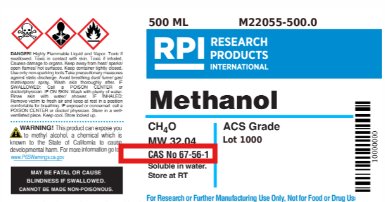
You can find the CAS number on the chemical bottle or on the Safety Data Sheet. If that is not providing the information, then go to Common Chemistry to search for the CAS number by chemical name.
7. What do I do if the chemicals in my inventory expire or are no longer wanted?
Manifest the chemical as waste after mentioning the reason for the removal and delete the chemical from the list once it is removed from the lab.
When chemicals are manifested through EHSA, their details are automatically removed from the inventory once they are collected from the lab.
If a chemical is still within its expiration date but is no longer needed for your research, please contact EHSA Support to arrange transfer or donation to other laboratories in need.
8. How often should inventory reconciliation be conducted?
Chemical inventory reconciliation must be performed at least once per year. The inventory should be kept current by adding newly acquired chemicals and removing expired or unwanted ones. Expired chemicals must be manifested before removal. A working inventory must always be maintained, with staff or designated lab personnel conducting an annual review to verify its accuracy. Contact EHS Chemical Safety for any questions or details.
9. How do I reconcile my chemicals?
Follow the instructions in the EHSA User Handbook.
10. How often do I have to reconcile my chemicals?
Laboratories, facilities maintenance areas, and all UAB areas in which chemicals are used or stored are required to reconcile chemicals annually prior to the lab inspections.
11. I ran out of chemical inventory barcodes. How do I get more?
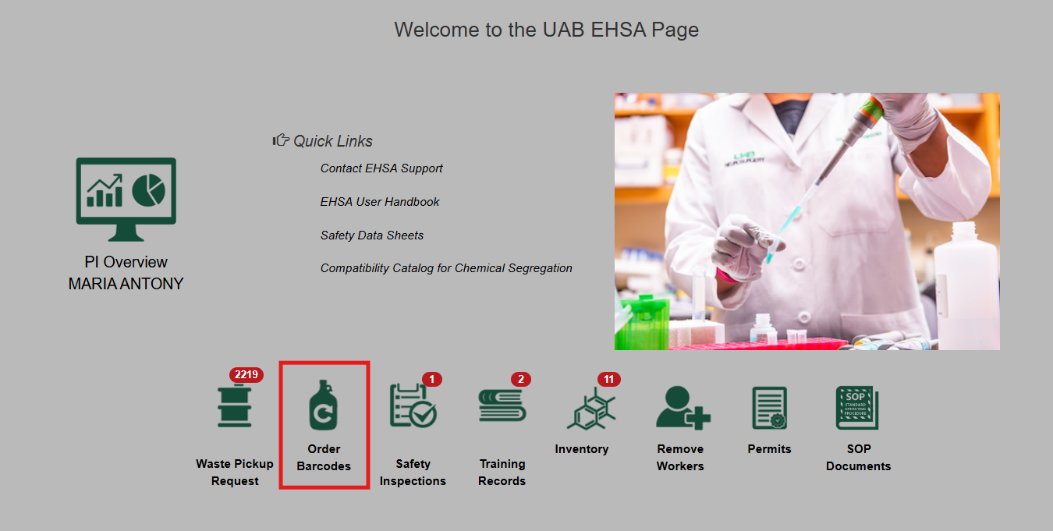
The UAB inventory barcodes can be ordered via the Order Barcodes feature in EHSA. Submit the order via EHSA and your barcodes will be delivered to your lab. The instructions for submitting orders are provided in the EHSA Handbook.
12. Can I use my own scanner to reconcile, or do I have to borrow one from EH&S?
EHSA is compatible with any barcode scanner. EH&S provides scanners for an initial period of 10 working days for reconciliation upon request and subject to availability.
13. I hear the scanner beep, but nothing is uploaded to a reconciliation page.
Verify that the scanner is paired with the computer used to access the EHSA program.
Ensure the mouse cursor is positioned in the Barcode field.
If both conditions are met and issues persist, direct questions to EHSA Support.
14. I do not have a desktop computer with internet in my lab. How can I reconcile?
You may use a laptop, tablet, or smartphone, and schools may provide devices on loan. The reconciliation process on these devices follows the same procedural steps as on a desktop computer.