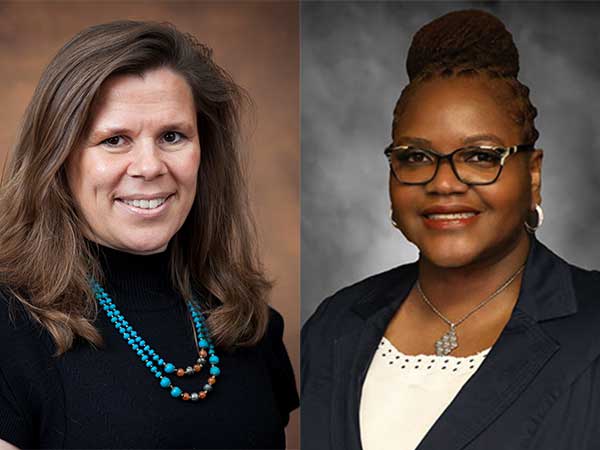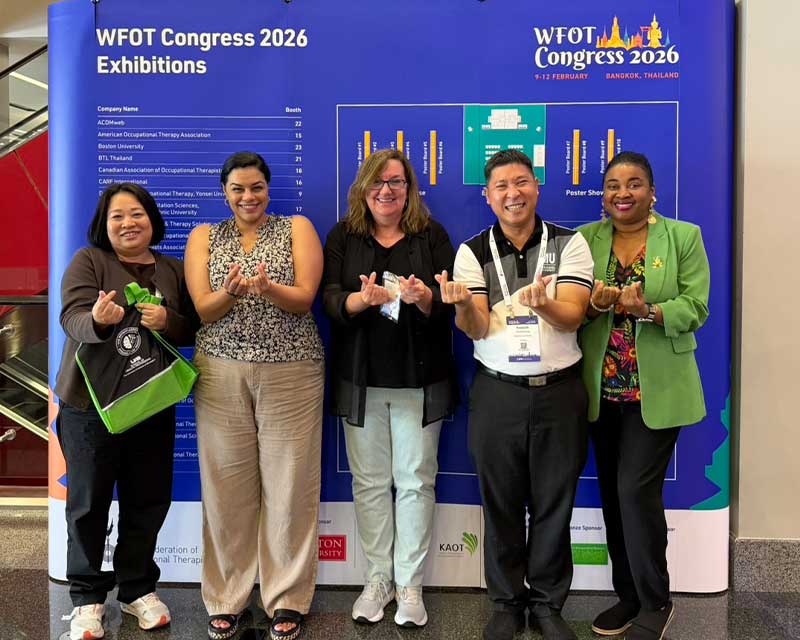
Global collaboration, the future of patient care, and artificial intelligence (AI) were at the center of the 19th World Federation of Occupational Therapists (WFOT) Congress, held in early February in Bangkok, Thailand. Seven UAB occupational therapy faculty members traveled to the international event, spending four days presenting research, exchanging ideas, and connecting with practitioners representing diverse health systems and cultural contexts.
For Associate Professor and Entry-Level OTD Program Director Jewell Dickson-Clayton, OTD, MPH, OTR/L, ATP, said this year’s theme, “Inspiring Change, Innovating Futures,” was evident throughout the congress.
“There was a strong emphasis on AI,” she said. “I learned a great deal about how it’s being used today and what it may mean for the future of education and direct patient care.”
She also emphasized the value of engaging with the international occupational therapy community. “We were able to showcase our programs while learning from colleagues across the globe,” she said.
Assistant Professor Valley McCurry, PhD, MBA, OTR/L, echoed that perspective.
“It was great to see the worldview on mental health and well-being,” said Dr. McCurry, who does research in this area. “We also had the opportunity to talk with people from all over the world as they stopped by our booth and to share information about our programs.”
For several faculty members, those global connections extended beyond formal conference sessions.
Global Engagement and International Partnership
While in Bangkok, Assistant Professor Mary Bowman, OTR/L, C/NDT, LSVT-BIG; Associate Professor and Entry-Level OTD Program Director Jewell Dickson-Clayton, OTD, MPH, OTR/L, ATP; and Assistant Professor Sarah dos Anjos, PhD, OTD, MS, OTR/L, met with faculty from Mahidol University’s Occupational Therapy Program to exchange ideas about curriculum and program development.
Dr. Dickson-Clayton said the connection was one of the congress’s most meaningful moments. “It gave us the chance to learn more about their research initiatives and explore possible future collaborations. It also reinforced our shared goal of strengthening occupational therapy in both countries,” she said.
Dr. Maliwan Rueankam, director of the program, and Dr. Supalak Khemthong, senior lecturer and international relations lead, welcomed the UAB group for discussion.
“We felt like fast friends after our meeting and hope to collaborate in the future,” said Ms. Bowman. “It was a pleasure to meet so many occupational therapists from around the world. We enjoyed sharing ideas and making new connections.”
Faculty also contributed new research and clinical insights during the congress.
Building Global Capacity in Low Vision Rehabilitation
Professor and Low Vision Rehabilitation Graduate Certificate Program Director Beth Barstow, PhD, OTR/L, SCLV, and Assistant Professor Jason Vice, PhD, OTR/L, SCLV, presented findings from an international, multidisciplinary training initiative designed to strengthen low vision rehabilitation services in regions with limited access. Their session examined training outcomes from the 2025 Low Vision Matters Conference held in Johannesburg, South Africa, attended by more than 60 professionals from South Africa, Namibia, and the United Arab Emirates.
Attendees, who included occupational therapists, optometrists, physiotherapists, and orientation and mobility specialists, reported increased confidence in providing low vision screening and intervention, as well as a clearer understanding of collaboration between occupational therapists and optometrists. The findings suggest that continued global training efforts can strengthen services and interdisciplinary partnerships.
Drs. Barstow and Vice noted that WFOT provided opportunities to discuss contextual differences in service delivery and identify strategies to enhance low vision services internationally.
Expanding Access to Evidence-Based Stroke Rehabilitation
Ms. Bowman and Dr. dos Anjos presented work focused on increasing clinical use and implementation of constraint-induced movement therapy (CIMT).
CIMT is highly effective for improving upper extremity function after neurological injury, but its intensive schedule can limit clinical use. Their poster introduced the Keys treatment protocol, a clinically feasible version that preserves all CIMT’s core components while distributing treatment over 8 weeks. This protocol provides shorter, more flexible sessions and prolonged engagement with the CIMT Transfer Package, which is associated with neuroplastic change and functional carryover. David Morris, PT, PhD, professor and chair of the UAB Department of Physical Therapy and interim dean of the School of Health Professions, is a co-author.
The results of a pilot clinical trial reporting promising results of the Keys protocol on upper extremity function, use, and quality of life were published in Brain Sciences in 2025.
Translating Neuroplasticity Research Into Practice
In a second poster presentation, Dr. dos Anjos and Ms. Bowman introduced a neuroplasticity-based approach (NBA) to help neurorehabilitation professionals integrate contemporary neuroscience evidence into practice. The NBA outlines five therapeutic aims guiding assessment and intervention. Dr. Morris is a co-author as well as lead author of a manuscript outlining the approach that is currently under review.
The presentation emphasized applying the NBA across clinical settings, including functional task practice, motivation, complementary techniques, health promotion, and behavioral strategies to support long-term participation and performance.
Interprofessional Service Learning and Community Health
Associate Professor Chris Eidson, PhD, OTR/L, delivered a lightning talk on We Can Do It! (WCDI), an interprofessional service-learning program designed to promote physical activity and healthy eating among individuals with intellectual and physical disabilities. The session highlighted outcomes from a large, multiprogram collaboration that last year involved 145 students, three community partners, and 96 community participants. Assistant Professor Rachel Ashcraft, MS, OTR/L, TBRI® Practitioner, is a coauthor.
The presentation demonstrated how integrating interprofessional education with community engagement strengthens interpersonal skills, supports accreditation standards, and prepares students for collaborative practice while benefiting community partners.