 Nominations for third-quarter 2026 are open through July 8; submit a nomination today. Kevin Jarrett, program coordinator II in the Center for Community Outreach Development; Martha Tankersley, associate vice president for the Comprehensive Transplant Institute; and Chelsea Tucker, associate director of First Year Programs in the Vulcan Materials Academic Success Center, are the second-quarter 2026 honorees for the UAB Values in Action Program.
The UAB VIP Award honors employees whose work exemplifies and embodies one or more of the We CARE Shared Values outlined in the Forging Ahead strategic plan: Collaborate, Act with Integrity, Respect All and Excel. All three honorees have made a lasting impact on the fabric and culture of UAB by exemplifying the university’s shared values.
Honorees are nominated by their colleagues and selected by a committee of individuals from across the campus and UAB Hospital. Nominations for third-quarter 2026 honorees are open through July 8; submit a nomination. One of the 2026 VIP honorees will be selected for the annual President’s Award for Excellence in Shared Values.
Meet this quarter’s UAB VIP Award honorees:
Kevin Jarrett
 Expanding access to STEM education across Alabama is a central focus of Kevin Jarrett’s work, and colleagues say his efforts have grown both the scale and impact of programs connected to UAB. As program coordinator II for the Center for Community Outreach Development, or CORD, Jarrett leads initiatives that reach students, teachers and schools across the state through hands‑on learning opportunities and competition‑based experiences.
That impact is especially visible through the Central Alabama Regional Science and Engineering Fair, or CARSEF. According to Jarrett’s fellow CORD Program Coordinator II Katie Busch, participation has increased significantly under Jarrett’s leadership, growing from around 200 students representing 10 counties to nearly 500 students across 20 counties and establishing CARSEF as the leading regional science and engineering fair in the Southeast. Jarrett’s "intentional outreach to rural and underrepresented communities has broadened access to STEM opportunities and strengthened the diversity and scale of participation,” Busch explained.
The impact of Jarrett’s efforts was on full display recently at the statewide Alabama Science and Engineering Fair. CARSEF students delivered what Busch called “a truly dominant performance,” earning 71 percent of all awards and taking two of the four overall top prizes, including the competition’s highest honor, Best in Show. In addition, seven CARSEF students have been selected to compete internationally at the Regeneron International Science and Engineering Fair.
“These outcomes are a direct reflection of the strength of the program [Jarrett] leads,” Busch said. “Under his leadership, students are not only participating, they are excelling at the highest levels.”
Beyond competition results, Jarrett’s work extends to building long‑term pathways for students. Busch says his outreach through GEAR UP Auburn reaches students across an additional 30 counties, increasing access to STEM education and introducing future scholars to UAB STEM programs. Highlighting the connection between his work and student recruitment, Busch added that “a significant number of participants in UAB CORD programs ultimately enroll at UAB.”
As his programs continue to expand, Jarrett has remained dedicated to the pursuit of excellence. From expanding the frequency and quality of teacher professional development offerings to overseeing the ethical standards of student research and programming on the Scientific Review Committee, he “consistently demonstrates initiative, reliability and a deep commitment to student success,” Busch said. “Kevin Jarrett embodies the very best of UAB.”
Martha Tankersley
 For decades, Martha Tankersley, associate vice president for the Comprehensive Transplant Institute, has helped shape UAB’s transplant program through a combination of leadership, collaboration and deep institutional knowledge, and colleagues say her influence can be felt across every part of the transplant enterprise.
Shikha Mehta, M.D., medical director of the Kidney and Pancreas Transplant Program, called Tankersley “a strong advocate for the program and its faculty.” During a recent challenging review process, Tankersley helped identify opportunities for improvement, and even more importantly, said Mehta, “she then partnered closely with the kidney transplant program … to implement meaningful changes that have improved patient outcomes.”
Mehta also points to recent innovations that have occurred under Tankersley’s leadership, including robotic kidney transplantation for donors and recipients, as well as her advocacy for the program on national platforms. Tankersley “is truly indispensable to our transplant program,” Mehta said.
A focus on building strong, connected teams is another defining part of Tankersley’s approach. Rebecca Burke, administrative director of the Histocompatibility Lab, said Tankersley “has the amazing ability to connect groups of people in a way that naturally lends itself to collaboration among teams.” One example is the quarterly new‑employee luncheons Tankersley’s organizes to bring staff together early and build relationships.
This spirit of collaboration was also instrumental in the creation of the Comprehensive Transplant Institute. “Her vision, commitment and leadership made it possible to unite all the transplant programs, research endeavors, ambulatory/inpatient areas and histocompatibility lab under one umbrella,” Burke said. “This was a monumental undertaking and has ensured the success of transplantation at UAB.”
Tankersley has created a culture of care and teamwork within the transplant program. Jordan DeMoss, executive vice president of Clinical Operations for UAB Medicine, recalls an incident in which a transplant patient was left alone at the clinic with a dead car battery. The care team pulled together to purchase a new battery, get it installed and support the patient throughout the process. “This type of can‑do, compassionate, and above‑and‑beyond care is a direct result of [Tankersley’s] example,” DeMoss said.
A recent survey by federal Centers for Medicare and Medicaid Services personnel underscores the level of excellence Tankersley has helped establish across the transplant program. The comprehensive and unannounced review of all of UAB’s organ sites resulted in a near perfect survey with only one, easily resolved technical finding.
“But while that may seem to be the highlight, it was the second-best part of the survey,” DeMoss added. One of the surveyors shared that Tankersley had been her transplant coordinator when she donated a kidney more than 30 years ago, and she has never forgotten her and the impact she had during that experience. For DeMoss, that moment captured the broader reach of Tankersley’s career — not only in program outcomes and institutional success, but in the lasting impression she leaves on patients and families.
Chelsea Tucker
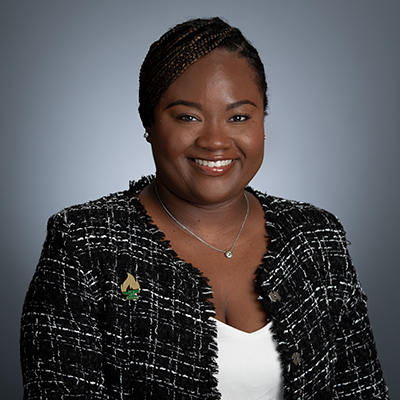 Helping students navigate the financial and administrative side of college is a central focus of Chelsea Tucker’s work in UAB’s Vulcan Materials Academic Success Center, or VMASC. Tucker’s colleagues say her approach has made those processes more accessible and supportive for UAB students. As associate director of First Year Programs, Tucker focuses on building connections that ensure students can find the resources they need to succeed.
That effort is especially evident in her work to bring campus partners together around student needs. A recent collaboration brought Financial Aid, Scholarships, Student Accounting and One Stop Student Services into a single workshop series designed to provide hands‑on support for students. The “BSMART & Get the Bag” series gave students the opportunity to “engage directly with campus partners, ask important questions, and receive hands-on support in completing applications related to financial aid and managing their student accounts,” said Brooke Walker, VMASC’s director of First Year Experience Programs.
The initiative’s structure reflects a broader approach to student support. Tucker is “intentional about building meaningful partnerships that center around the needs of students,” Walker said. By bringing multiple offices together in one space, initiatives like “BSMART & Get the Bag” create an environment where students can more easily access information and take next steps with confidence, Walker adds.
That focus on collaboration also addresses challenges students may face outside the classroom. According to Walker, the initiative reflected Tucker’s “deep understanding of the barriers students may face and her proactive approach to addressing them.” Highlighting the broader impact of Tucker’s work, Walker explained that the “BSMART & Get the Bag” workshops were designed to make students feel empowered and informed, which “ultimately contributes to student persistence and retention.”
In addition to spearheading student-focused initiatives, Tucker’s day‑to‑day approach to her role is noted by colleagues. “She not only works well with others, but elevates those around her, fostering a culture of shared purpose and student-centered service,” Walker said. “Her work continues to make a meaningful difference in the lives of UAB students and the campus community as a whole.”