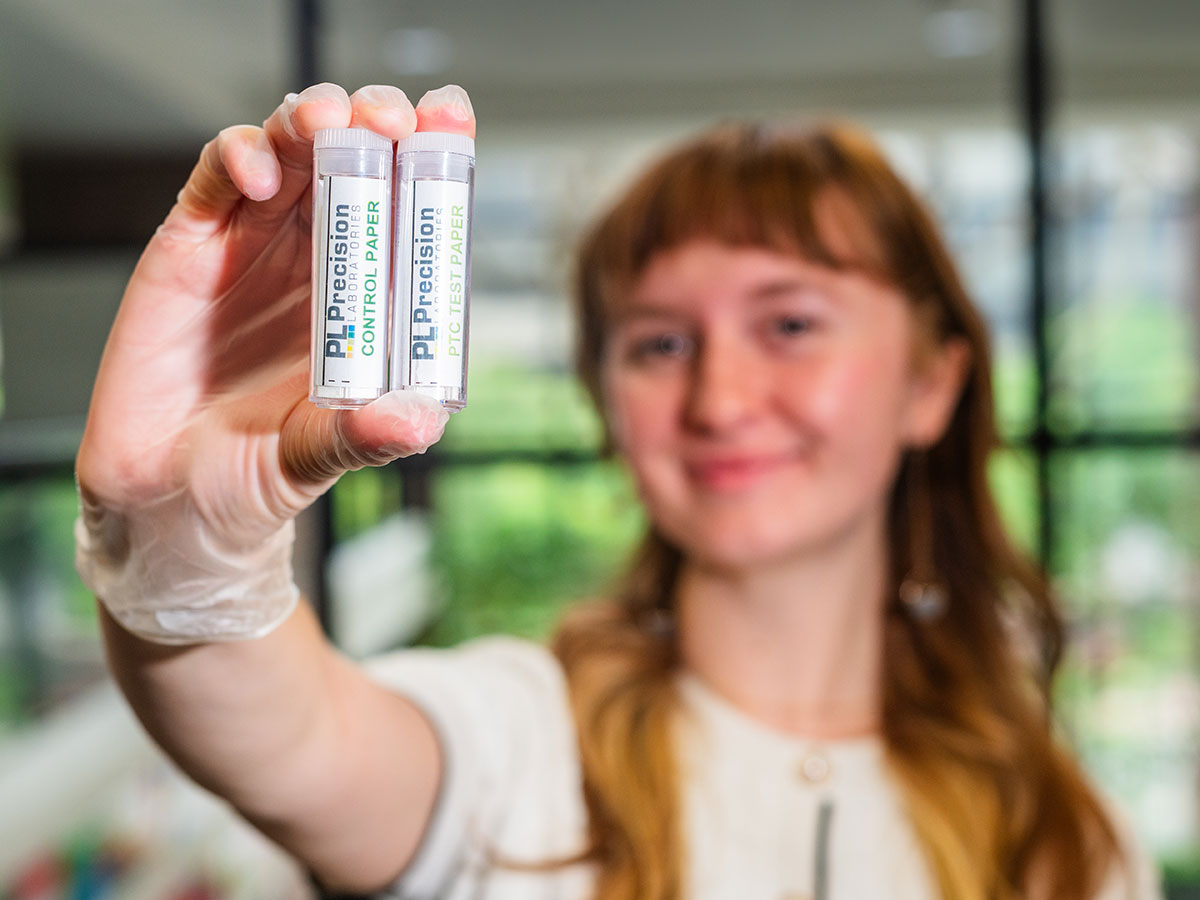
 UAB behavioral neuroscience doctoral student Ava Piper is the activity director of Brain Snacks, a grad student-run outreach of the Comprehensive Neuroscience Center's Neuroscience for All program. Here, Piper holds up control and test strips for her favorite Brain Snack activity: the PTC paper experiment.Photo by Ian Logue, UAB Marketing and Communications
Are you a “super taster”?
If you are strolling around the booths at popular Birmingham gatherings such as Taco Fest and ComicCon, you will more than likely get the chance to find out.
Brain Snacks, a graduate student-run outreach of the UAB Comprehensive Neuroscience Center’s Neuroscience for All program, has been a regular presence at these events for the past several years. Brain Snacks volunteers offer passersby the chance to take part in hands-on demos designed to open the eyes of children and adults alike to the wonders of brain science.
Ava Piper, a student in UAB’s behavioral neuroscience doctoral program, is the activity director for Brain Snacks. She and a group of roughly a dozen similarly energetic grad students staff the Brain Snacks table at major Birmingham events throughout the year, giving hundreds of people the chance to take part in simple, interactive demonstrations.
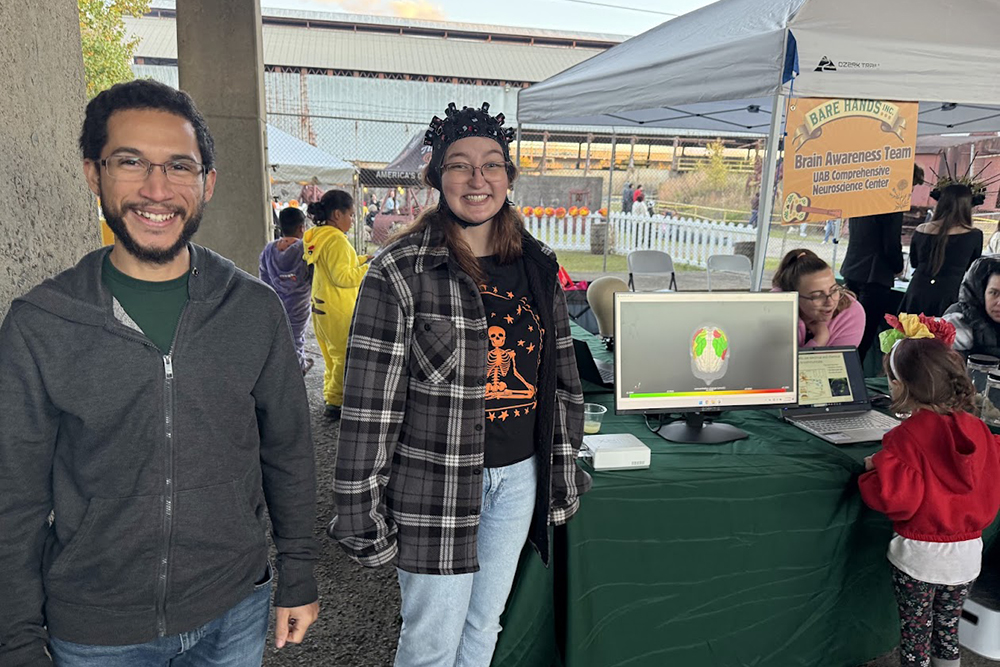 Brain Snacks volunteers at Birmingham's Day of the Dead festival. Photo courtesy of UAB Neuroscience for All
Super tasters revealed
Related story: How one UAB researcher is bringing neuroscience to the community. Learn more about Neuroscience for All in this UAB News feature.
Piper’s favorite is the PTC paper experiment. She hands volunteers two small paper strips that they put in their mouths. The control strip is just a piece of paper — it has no taste. The PTC strip contains a chemical that some people don’t detect at all; for others, it has an extremely bitter taste. It all comes down to a gene called TAS2R38, Piper explains. People who have the dominant trait are the “super tasters,” who experience the PTC paper as so bitter they often spit it out. People who have the recessive gene trait taste nothing.
“It’s so fun to watch people look around and realize they’re having a completely different taste experience than the person next to them,” Piper said. “This demonstration does an incredible job at teaching how our body and our genetics can influence our behavior and preferences.”
Each of the Brain Snacks demos is designed to be quick and memorable. Other popular demos are prism goggles — which alter the path of light to the brain and interfere with participants’ ability to throw a ball at a target, until the brain adapts — and the two-point discrimination task, in which the brain doesn’t register separate touches on the forearm if they are close together. “The best hands-on demos are really teaching people that they can discover for themselves how the world works,” said Kristina Visscher, Ph.D., associate professor in the Department of Neurobiology and leader of Neuroscience for All. “We can change someone’s brain for a few minutes and then they go back along with their lives.”
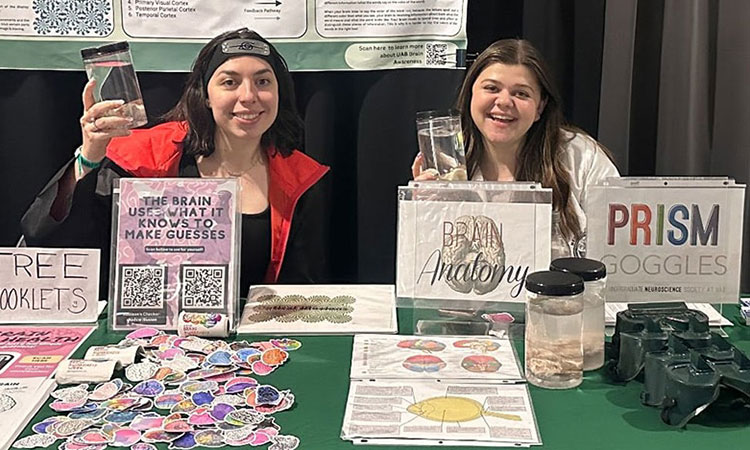 Brain Snacks student volunteers at Iron City Comic Con. Note the prism goggles at right. Photo courtesy of UAB Neuroscience for All
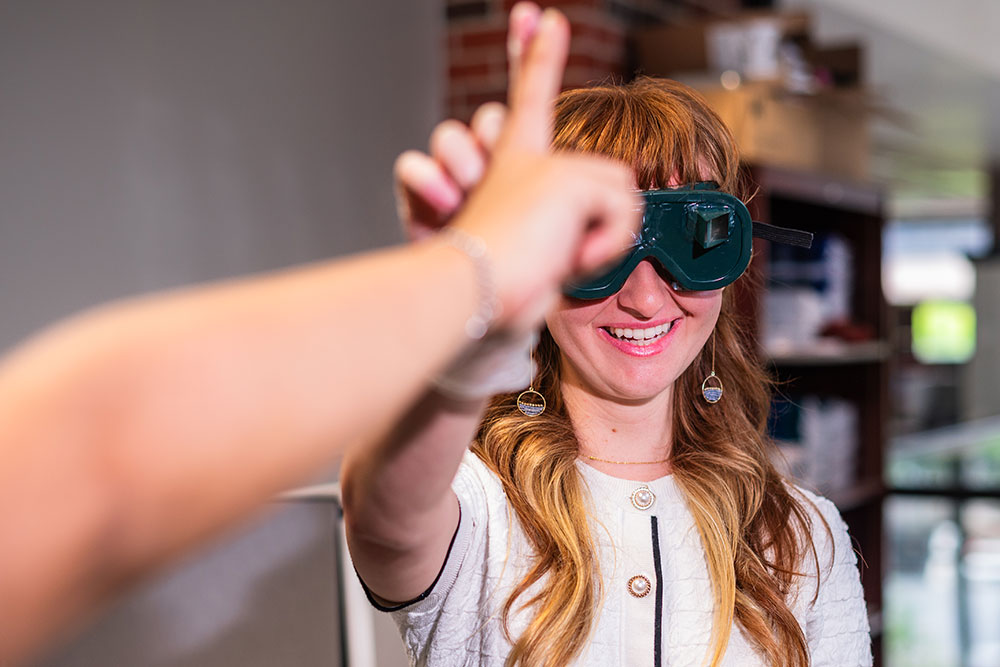 Piper demonstrates prism goggles, which alter the path of light to the brain and make it difficult to throw a ball or touch fingers with a friend until the brain adapts. Photo by Ian Logue, UAB Marketing and Communications
Snacks help scientists share their work
Piper joined the Brain Snacks team in 2024 and took over as director last fall. “I got involved because I am so fulfilled by teaching and science communication,” she said. “I think it’s important for scientists to be able to talk about their work to people across all ages and education levels.”
Piper’s work, in the lab of Robert Sorge, Ph.D., professor in the Department of Psychology, is focused on assessing treatments for chronic pain. Brain Snacks gives her the chance to talk about her research with the public, including sharing material about pain treatment, management and healthy behaviors. When appropriate, she also shares recruitment flyers for the lab’s studies. “It’s so exciting speaking with community members about how they can play a role in improving pain research, even if they do not experience chronic pain themselves,” Piper said.
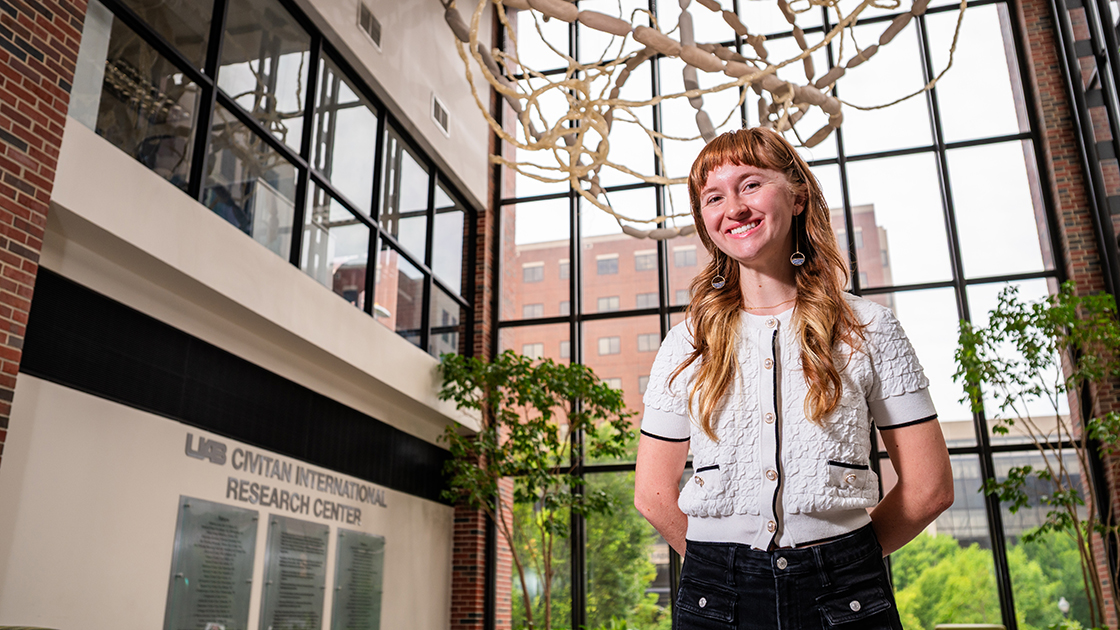 "I aim to inspire future scientists in every single one of my presentations and demonstrations," Piper said. Photo by Ian Logue, UAB Marketing and Communications
Aiming to inspire
Piper chose UAB for her graduate studies primarily because of its “emphasis on valuing diverse experiences,” she said. “I have been able to work in several research labs, ranging from neurobiology to psychology, through my doctoral program’s rotation system. My research experience and skills have grown exponentially since joining the program.”
Her teaching skills have also benefited from taking part in Brain Snacks, Piper adds — and the opportunity to help spark an interest in science among young people is always motivating. Her most memorable Brain Snacks presentation was during a STEAM Night event at Birmingham’s i3 Academy school. “The event generated curiosity across all ages, and watching families discuss amongst themselves about the experiments they were doing was so rewarding,” she said. “I aim to inspire future scientists in every single one of my presentations and demonstrations.”
Take a Brain Snack to your event
Members of the UAB community are invited to take part in the Brain Snacks program. “If you are a staff member, student or researcher who knows a bit about the brain, and you want to bring some information to an event — like a 5K, for instance — we have these bags that are filled with a hands-on activity that we have already taught to a large number of people,” said Kristina Visscher, Ph.D., who leads UAB’s Neuroscience for All program. “We’ve designed it like a library, where you can just come and check out a bag. We can also teach you and give you the tools and instructions on how to do it.” (UAB community members can
Learn more about Brain Snacks and how to share them at the next Brain Bites meeting, at 2 p.m. Sept. 2 in room 105 of the Shelby Building.
More opportunities to learn
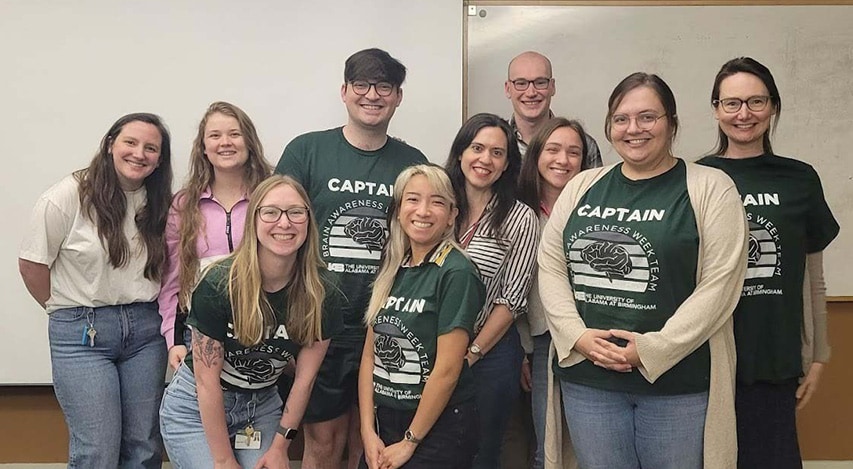 Kristina Visscher, Ph.D. (right) and members of the Neuroscience for All team Photo courtesy of UAB Neuroscience for All
Brain Snacks are just one part of the UAB Neuroscience for All program. Others include:
- Brain Awareness Week: This signature event, held each spring at Birmingham’s McWane Center, features more than 100 UAB student, faculty and staff volunteers teaching thousands of visitors.
- Brain Chats: These informal talks by UAB experts at the Hoover Public Library are held every second Saturday at 11 a.m.
- Brain Bites: Held each semester, these events bring together anyone in the UAB community and beyond (faculty, staff or students) who is interested in making neuroscience accessible to discuss upcoming outreach opportunities.