



- Four UAB police officers walk in pairs with hands pointed outwards during training exercise
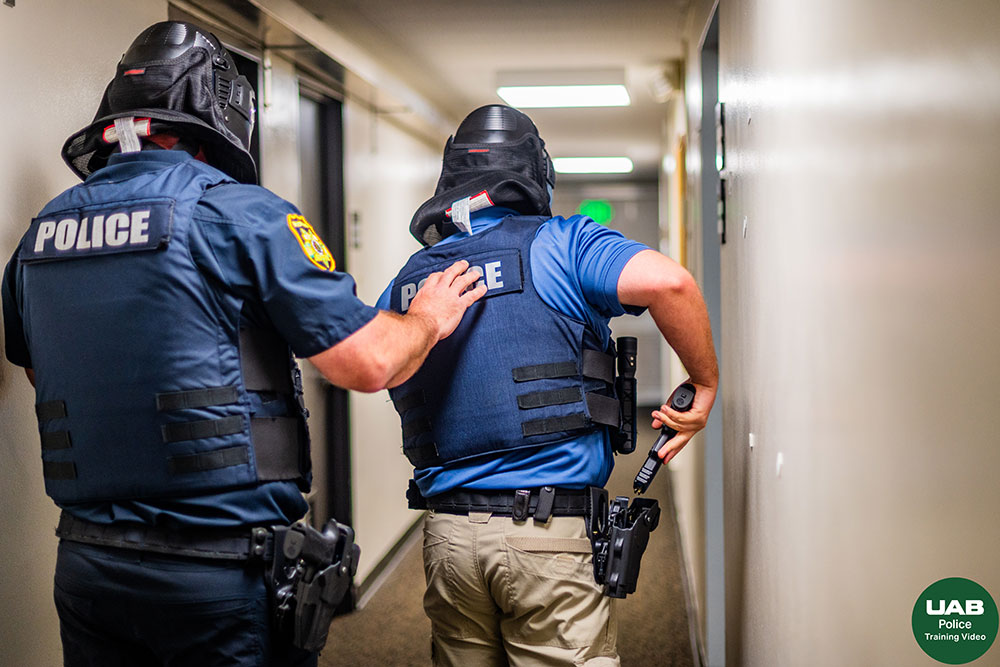
- Two police officers wearing bulletproof vests and headgear move down a hallway
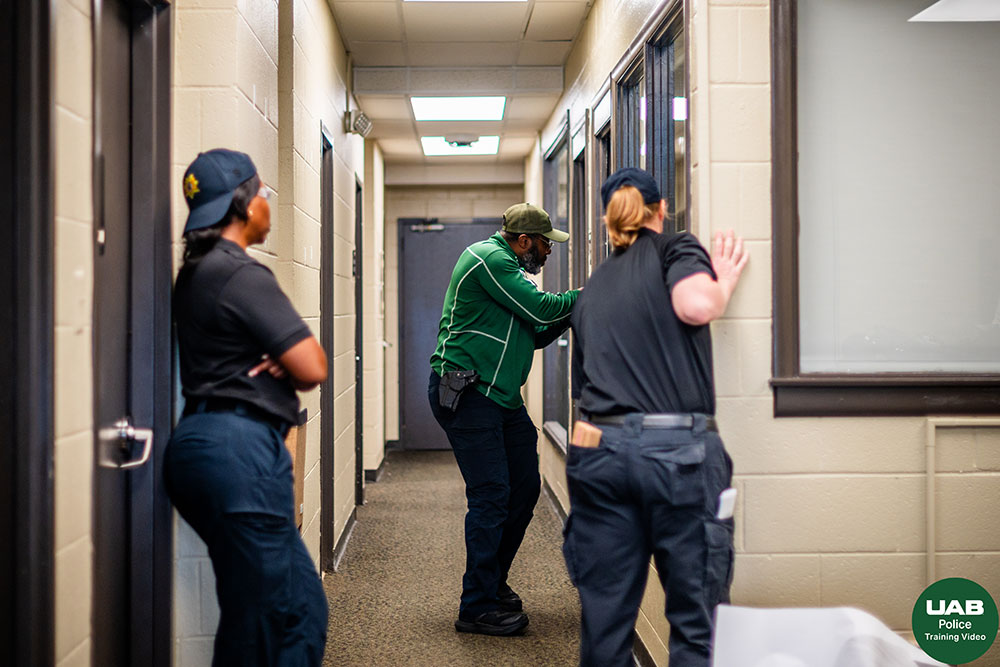
- Three officers look toward an open doorway during a training exercise
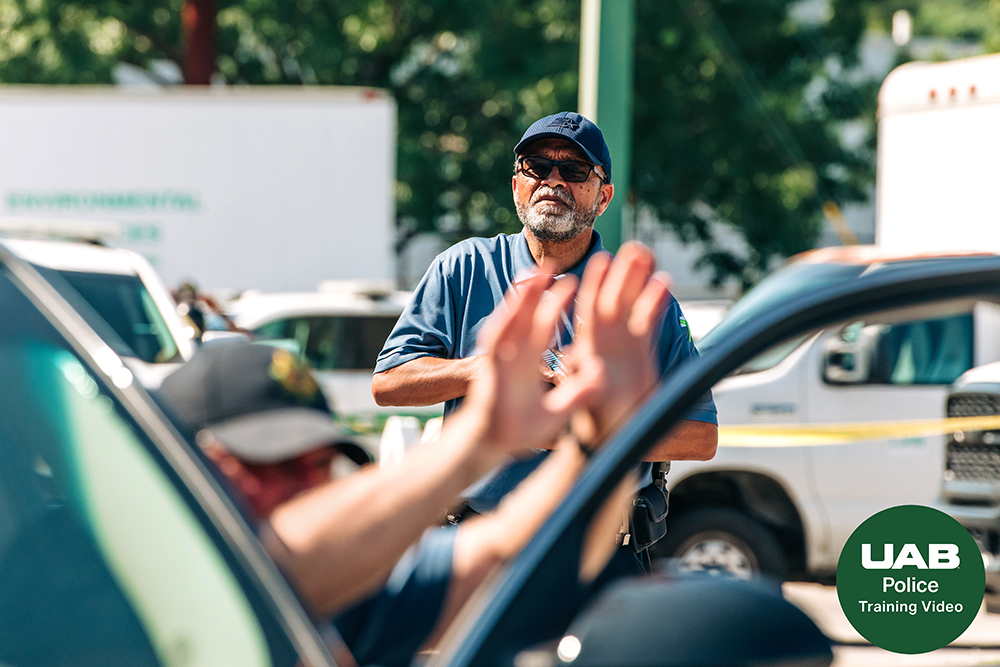
- A participant raises his hands while a police officer approaches from behind
- Two participants talk in the center of the frame while dozens of participants gather in small groups or at computers behind them
- Chief Green and a participant talk during the training exercise
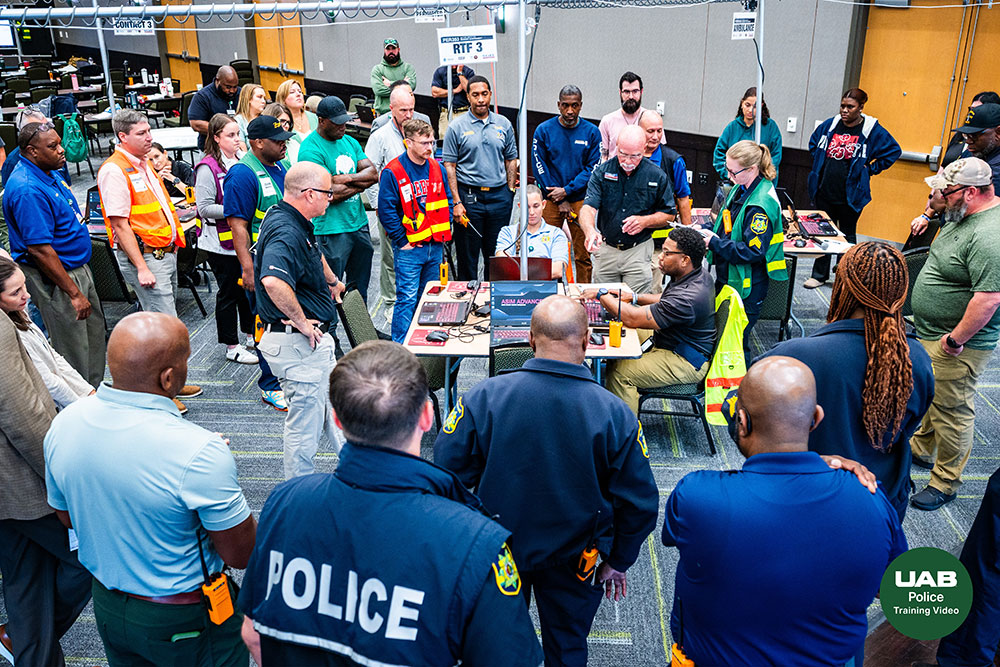
- Dozens of participants gather around a central table in an exercise
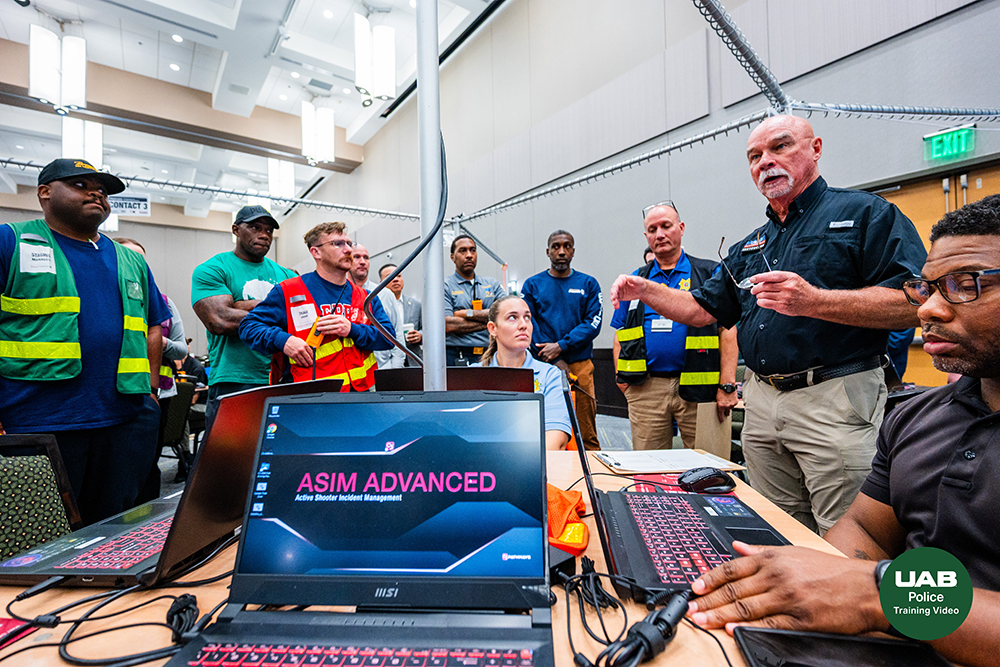
- A laptop computer in the foreground reads ASIM Advanced while officers gather in a group around a table
- Participants wearing orange vests talk and other participants stand behind in this training exercise
-
Every UAB patrol officer participated in a full-day Advanced Law Enforcement Rapid Response Training session over a five-week period in May and June. “These were extensive active-threat training efforts,” said UAB Police Chief Daryl Green.
-
Every UAB patrol officer participated in a full-day Advanced Law Enforcement Rapid Response Training session over a five-week period in May and June. “These were extensive active-threat training efforts,” said UAB Police Chief Daryl Green.
-
Every UAB patrol officer participated in a full-day Advanced Law Enforcement Rapid Response Training session over a five-week period in May and June. “These were extensive active-threat training efforts,” said UAB Police Chief Daryl Green.
-
Every UAB patrol officer participated in a full-day Advanced Law Enforcement Rapid Response Training session over a five-week period in May and June. “These were extensive active-threat training efforts,” said UAB Police Chief Daryl Green.
-
UAB Police and Public Safety also hosted three days of Active Shooter Incident Management training in August. UAB PD hosted agencies from Jefferson County and around the state. Among the campus groups who participated were UAB Hospital and Campus officers, Emergency Management, Student Affairs, the Office of Marketing and Communications and others. “Statistics show that UAB has a relatively safe campus, compared to our peer institutions,” Green said. “That said, our success depends on sustained preparedness, vigilance and partnership across the university.”
-
UAB Police and Public Safety also hosted three days of Active Shooter Incident Management training in August. UAB PD hosted agencies from Jefferson County and around the state. Among the campus groups who participated were UAB Hospital and Campus officers, Emergency Management, Student Affairs, the Office of Marketing and Communications and others. “Statistics show that UAB has a relatively safe campus, compared to our peer institutions,” Green said. “That said, our success depends on sustained preparedness, vigilance and partnership across the university.”
-
UAB Police and Public Safety also hosted three days of Active Shooter Incident Management training in August. UAB PD hosted agencies from Jefferson County and around the state. Among the campus groups who participated were UAB Hospital and Campus officers, Emergency Management, Student Affairs, the Office of Marketing and Communications and others. “Statistics show that UAB has a relatively safe campus, compared to our peer institutions,” Green said. “That said, our success depends on sustained preparedness, vigilance and partnership across the university.”
-
UAB Police and Public Safety also hosted three days of Active Shooter Incident Management training in August. UAB PD hosted agencies from Jefferson County and around the state. Among the campus groups who participated were UAB Hospital and Campus officers, Emergency Management, Student Affairs, the Office of Marketing and Communications and others. “Statistics show that UAB has a relatively safe campus, compared to our peer institutions,” Green said. “That said, our success depends on sustained preparedness, vigilance and partnership across the university.”
-
UAB Police and Public Safety also hosted three days of Active Shooter Incident Management training in August. UAB PD hosted agencies from Jefferson County and around the state. Among the campus groups who participated were UAB Hospital and Campus officers, Emergency Management, Student Affairs, the Office of Marketing and Communications and others. “Statistics show that UAB has a relatively safe campus, compared to our peer institutions,” Green said. “That said, our success depends on sustained preparedness, vigilance and partnership across the university.”
More than 100 University of Alabama at Birmingham Police and Public Safety officers spent part of their summer in hands-on, scenario-based training designed to sharpen their response to potential emergencies.
Every UAB patrol officer participated in a full-day Advanced Law Enforcement Rapid Response Training session over a five-week period in May and June. Additional ALERRT and Active Shooter Incident Management trainings were also held in July and August. The exercises included both indoor and outdoor scenarios to simulate real-world conditions.
“These trainings are about preparedness,” said UAB Police Chief Daryl Green. “We’ve seen active-threat incidents happen at campuses, hospitals and communities across the country, and we are committed to making sure our officers can respond quickly and effectively to any threat.”
The large-scale effort is part of a continual focus on readiness.
Meeting someone to buy, sell or trade an item? Use UAB’s Trade Safe Zone at the Police and Public Safety Department parking lot for a safer exchange.
“Our officers train year-round,” Green said. “This summer’s full-scale ALERRT sessions further strengthen our ability to respond quickly and effectively should an emergency occur.”
The scope of the trainings was intentional. Officers rotated through multiple scenarios to ensure every patrol officer gained practical, hands-on experience in a controlled environment.
“These were extensive active-threat training efforts,” Green said.
The emphasis on training and preparedness comes as UAB continues to see significant positive public safety trends across campus and the UAB Health System.
“Training, preparation and strong partnerships across the university and health system all contribute to creating a safer environment for our campus community,” Green said.
Comparisons with peer urban universities show UAB has consistently performed favorably across several major safety categories over recent years.
“Statistics show that UAB has a relatively safe campus, compared to our peer institutions,” Green said. “That said, our success depends on sustained preparedness, vigilance and partnership across the university.”
Through continued training, collaboration with public safety partners and a commitment to improvement, UAB Police and Public Safety aims to ensure the campus remains a safe environment for students, faculty, staff, patients and visitors.
Layered public safety approach
While real-world training scenarios are vital to preparedness, a long-time emphasis has been providing a layered public safety approach to deter and respond in real time to threats.
Download the Rave Guardian campus safety app now. It is a simple way to report suspicious activity or contact UAB Police.
As an example, UAB Police officers monitor feeds from many of the more than 7,000 security cameras across the UAB enterprise in the Security Operations Center.
“We view the Security Operations Center as the clearinghouse for all threats on the campus and in the Health System,” Green said. “Our officers monitor cameras particularly in high-peak areas and during emerging situations, such as if there is a major public event.”
If officers need to respond, the SOC can provide real-time information about a suspect’s actions, descriptions and patterns of travel. The SOC also communicates directly with the UAB Center for Patient Flow to help divert patients and staff from disturbances.
Green also credits the SOC and its integration of drones, crime-trend monitoring and other tools for helping officers identify patterns and respond more quickly to emerging threats. In UAB Hospital and UAB Medicine campus clinics, UAB Police work closely with the Center for Patient Flow, Health System Safety and Security, and hospital crisis response teams to address disruptive and potentially violent incidents involving patients and visitors.
The department’s two canine teams — featuring Dolly and Daks — continue advanced explosives- and firearms-detection training, supporting safety efforts across campus and within the health system.
“You can never be too prepared when it comes to safety,” Green said. “Continuous improvement in training, technology, communication and readiness is always our goal.”