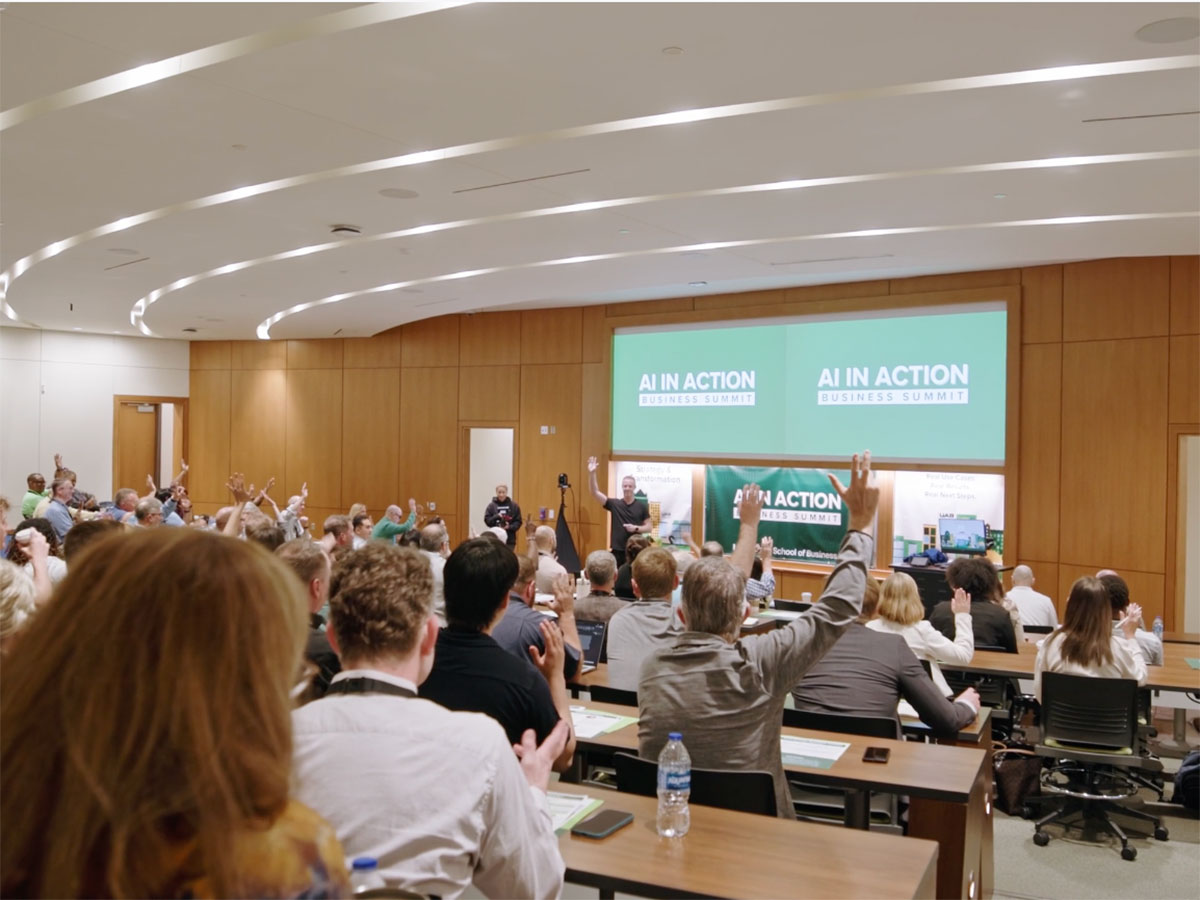
 The AI in Action: Business Summit at the Collat School of Business in April 2026 attracted hundreds of attendees. Read answers to select audience questions, along with UAB faculty advice from Collat's "AI in a Minute" video series, below.In early May, UAB launched the AI Strategic Initiative, an enterprise-wide effort to understand and capture current AI activities at UAB, identify opportunities at the local and enterprise levels, and establish structures and guidance across all aspects of UAB’s mission.
Many of the questions facing units across campus are also being asked across industries: Where should we start? How can we keep up? And what pitfalls should we keep in mind? The perspectives below are intended to provide context and spark thinking as UAB continues developing its own approach to responsible and mission-aligned AI use.
In April, the UAB Collat School of Business hosted the AI in Action: Business Summit, bringing together business leaders, industry experts, and UAB faculty and students to discuss how companies are finding value in AI today. You can watch a recap from the event here, and check out the portfolio of non-credit AI courses for professionals offered by the Collat Professional Education team.
Throughout the summit, attendees were able to submit questions through a QR code. Speakers answered a few during the event; but with more questions than time allowed, Collat later shared the questions with speakers and invited additional responses.
Some highlights of their answers are below. We also gathered additional advice from UAB faculty shared in Collat’s “AI in a Minute” video series on Instagram.
Q: What AI-related skills will employees need most in the future?
“A big challenge for everyone is that learning AI isn’t like learning traditional software. It’s more like learning to delegate, set clear expectations, provide the right resources and give good feedback.”
— Austin Senseman, M.S., Birmingham AI
Q: Is using AI “cheating”?
“Let’s first pump the brakes and ask, ‘What is cheating?’ That is using something that’s not yours to get something you didn’t earn. So, yeah, we need to be careful, because first we need to think about what we might be using AI for. Copying and pasting into an email might signal to your boss that you’ve turned off your brain and you’re just copying and pasting junk, which is not what you want your boss to think about. Also, and probably most importantly, you might just be rotting your brain by using AI. Again, there’s nothing wrong with AI; but if everything you are doing with AI is to turn off your brain — you are never writing, never thinking, you never do any analytics — your brain might just be atrophying, according to new research that is coming out.”
— Ben Meadows, Ph.D., Assistant Professor, Department of Marketing, Industrial Distribution and Economics, Collat School of Business (see the full video with Meadows on Instagram)
Q: How can I avoid becoming overly dependent on AI?
“Make sure you always have your own original idea, opinion or draft before approaching AI for input. This makes sure you’re still thinking for yourself. Also, don’t strive for perfection. Strive for growth and learning. We often go to AI for the perfect answers and to avoid making mistakes; but when we do that, we interrupt our own learning journey.”
— Vitale Buford Hardin, Hardin and Company
Q: Will AI replace me?
“AI is not your competition. It is your amplifier. But here’s the real question: Are you developing the soft skills AI cannot replace? AI can process information; but it cannot build trust, it cannot read a room, it cannot sense hesitation in someone’s voice, and it cannot lead a difficult conversation with integrity. The professionals who will thrive in the age of AI will combine technical fluency with emotional intelligence and critical thinking. AI raises the bar for being human.”
— David Wilson, MBA, UAB Center for Sales Leadership, Collat School of Business (see the full video with Wilson on Instagram)
Q: How do you put effective guardrails around AI use while still encouraging curiosity, experimentation and accountability?
“As I see it, AI needs to focus on establishing a ‘minimal viable governance’ (MVG) layer that has as small a set of rules as a company’s risk appetite can handle. The idea is to have a small set of non-negotiables (e.g., data classification used to determine what can be placed into public tools versus proprietary tools, human-interrupted steps for business processes that may be considered high value or high risk, and approved tool guidance with explanation). This essentially creates a basecamp or springboard to build on top of as AI usage evolves and establishes a firm foundation to be forward-thinking in protecting the organization.”
— Paul Di Gangi, Ph.D., Professor, Department of Management, Information Systems and Quantitative Methods, Collat School of Business
Q: I tried AI and it didn’t work for me. What do you recommend?
“Maybe that was your experience. But AI is evolving fast. New updates are happening all the time. If you haven’t checked in lately, give it another try. You might be surprised at how much it has improved.”
— Jennifer Edmonds, Ph.D., Faculty Fellow for Graduate Programs, Associate Professor, Collat School of Business (see the full video with Edmonds on Instagram)