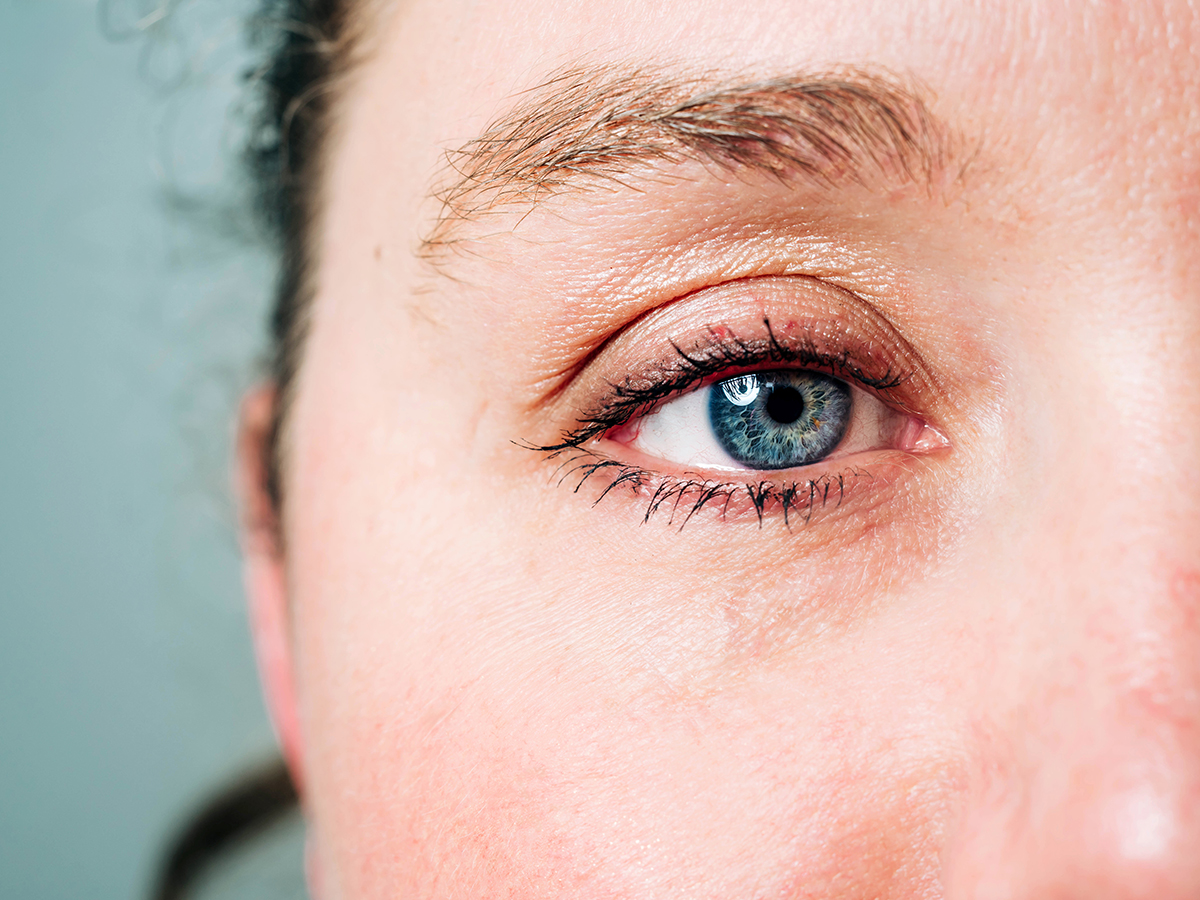
 Staring at screens all day reduces blinking, which prevents proper tear release and leads to a dry, gritty feeling. Photo by Andrea Mabry, UAB Marketing and CommunicationsAnyone whose job involves looking at a screen — a category that includes most of the workforce today — has an increased risk for dry eye disease.
“When we are staring at a computer, our blink rate goes down or we don’t blink fully,” said Mallory Wright, O.D., an assistant professor in the UAB School of Optometry and an optometrist at UAB Eye Care who treats patients at the Dry Eye Relief Clinic. The specialty clinic has seen an increase in patients over the past several years, including young adults and even children, Wright says. (Women, and those over age 50, have higher risk for dry eye disease in general.)
Dry eye symptoms
If the upper and lower lids do not close fully during a blink, “they do not release tears or the tears evaporate really quickly,” Wright said. “That makes your eyes feel dry and gritty, because the eyelid is rubbing directly on the surface of the cornea.”
Another major sign of dry eye disease is intermittent blurry vision. “Patients say they are constantly trying to blink to make things clear,” Wright said. A third common, but counterintuitive, symptom: eyes that are overly watery. “The eyes want more tears, because they are not good quality, so the patients end up with constant tearing of the eye,” Wright said. “We have to treat their dry eye to correct that.”
 Mallory Wright, O.D.When is it time to talk to your eye doctor about dry eye symptoms? “Any time you are feeling these symptoms — a dry, gritty feeling; intermittent blurry vision; or excessive watering — it’s good to see your optometrist,” Wright said. “Don’t wait for your annual eye exam — there are so many things we can do to help.”
Preventing dry eye: Use the 20/20/20 rule
One way to increase your blink rate and protect your eyes is to follow the 20/20/20 rule when working: “Every 20 minutes, you take a 20-second break to look 20 feet away,” Wright said. “That resets your focus and allows your eyes to adjust.”
For relatively mild cases, the first step in treatment is generally over-the-counter artificial tears, Wright says. Early treatment is better, as dry eye may progress if ignored long enough. “Dry eye disease is a chronic inflammatory condition that gets progressively worse if it is not treated,” Wright said. “We are definitely seeing an increase in younger adults and even children with dry eye. That has led us to be more aggressive in treating it before the issue becomes more of a problem.”
To make an appointment with UAB Eye Care, schedule online or call (205) 975-2020.
Diagnosing dry eye disease
There are two main types of dry eye disease, based on the specific part of the tear film that is impacted. “Tears are made up of a little bit of oil, a little bit of water and some mucin,” Wright said. Evaporative dry eye involves the oil-producing meibomian glands in the eyelid. Aqueous deficient dry eye is caused by not enough water in tears. (Increased hydration can help here.)
Without proper blinking, the meibomian glands can become clogged, stopping the flow of oil into tears. The majority of dry eye cases are related to meibomian gland issues, Wright says. And if the problem continues long enough, it is possible for these glands to die, in which case “we do not routinely see them come back,” Wright said.
Contact lens wearers and people who took the acne medicine Accutane (which targets oil glands) are at higher risk for dry eye. Scleral contact lenses, custom made to the patient’s eye, are one option for patients who are experiencing eye discomfort but want to continue wearing contacts. They are filled with fluid and can keep the eye hydrated constantly, Wright says. There is also an autoimmune disease, known as Sjogren’s syndrome, that can cause dry eye, so proper diagnosis is critical to bringing patients relief.
“In our initial evaluation” at the Dry Eye Relief Clinic, “we do a comprehensive exam looking at inflammation on the surface of the eye, the saltiness and the oil content of your tears,” Wright said. “We can also image the meibomian glands and count them. Then we create a customized treatment plan specific to you.”
Therapies for dry eye disease treatment
In addition to prescription-strength eye drops, one first-line treatment used in the Dry Eye Relief Clinic is a heated eye mask, which patients wear for five minutes each night “to help melt those oils in the meibomian glands and prevent clogs,” Wright said. “We want the oil to be like olive oil instead of butter. Clogged butter won’t come out of the glands.”
In-office therapies at the Dry Eye Relief Clinic include intense pulsed light therapy and a device that heats the meibomian glands, allowing the clogged oil to be expressed in office. “That is a really good alternative if someone is not good with drops and doesn’t want to be on medication,” Wright said.
In most cases, treatment will reduce or eliminate symptoms. “People don’t realize their eyes are so dry until we start treating them,” Wright said. “And then they say, ‘I didn’t realize my eyes could feel so good.’”