by Satina Richardson
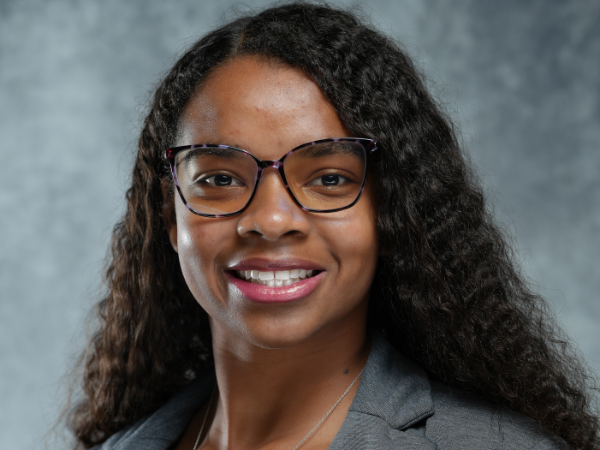
Malia McDowell, Class of 2026, is the first recipient of the Alabama Optometric Rural Service Scholarship, receiving $134,000 to practice in an underserved rural community in Alabama.
There is a growing need for eye care in rural and underserved communities across the state, and this scholarship for optometry students helps address that need. Applicants must complete a rigorous application and interview process.
“Many smaller towns have limited access to optometric services, and in some areas, patients must travel significant distances for routine eye care,” said Lynn Hammonds, OD, alumna and Alabama Board of Optometric Scholarship and Loan Awards chair. “This scholarship is designed to encourage new graduates to consider practicing in these communities by helping offset some of the financial burden they face as they begin their careers.”
A list of qualifying counties is provided to ensure that scholarship applicants select an area that is statistically proven to be in need.
McDowell chose to establish a practice as an independent optometrist at a Walmart Supercenter in Valley, AL, located in Chambers County. This area has more than 34,000 residents and is considered critically underserved, having only a part-time optometrist providing care.
This was a thoughtful decision that she and her fiancé made together after recognizing both a need and an opportunity.
“We were looking for a place to potentially call our forever home, and Chambers County stood out immediately,” she said. “The Walmart location had gone years without an optometrist, and the need was clear. So, we visited, then we visited again.”
While McDowell was juggling optometry school, board exams, and preparing for the rigorous scholarship interviews, the couple found time to experience the everyday nuances of the area. They imagined what daily life might feel like and found it to be a “hidden gem.”
She applied for the scholarship because she values the positive impact of serving in underserved communities.
“When I think about why I applied for this scholarship, I think about the countless hours of volunteer work that made me who I am today,” she said. “In early middle school, my mom used to drag me out of bed on Saturdays at 5:00 a.m. to volunteer. I remember crawling around cold community center floors, organizing fruits and vegetables for families.”
In high school, she participated in two cultural immersion trips involving volunteer projects in Costa Rica and Peru, where she saw extreme poverty for the first time. During the COVID-19 pandemic as an undergraduate and throughout optometry school, she continued to serve.
“In optometry school, if I had the time available, I was volunteering,” McDowell said. “From establishing and participating in vision screenings and mission trips to becoming an Albert Schweitzer Foundation of Alabama Fellow.”
Albert Schweitzer Fellows are graduate students who design and carry out community service projects that address unmet health needs.
The Community of Hope Health Clinic (CHHC) was her project site. CHHC provides care for residents of Shelby County who live at or below 200 percent of the federal poverty level and lack access to insurance. Two retired UAB Optometry alumni established a practice there to serve patients in need. McDowell joined during her fellowship year to help enhance patient care.
“Each experience deepened my passion to serve others and led me to apply to this program,” she said.
Through her involvement with the Private Practice Club, she met alumni who worked in small communities. They spoke highly of their careers and expressed a strong sense of fulfillment.
Support from her fiancé further reinforced her commitment to practicing in a rural area.
“Receiving the scholarship didn’t make our decision; it confirmed it,” she said. “[My fiancé and I] always talk about how comfortable things are in the places we know. Sometimes, if you don’t jump, you may never—and I am beyond blessed to take this leap.”
McDowell, of Clarksville, TN, plans to use a portion of the scholarship to build the foundation of her practice, including establishing an electronic health record system, scheduling software, and hiring staff. She also plans to work closely with a CPA to ensure financial stability.
“We hope Malia will become an integral part of her community by providing much needed access to comprehensive eye care,” Hammonds said. “In rural areas, optometrists are often the primary providers of vision care, early disease detection, and ongoing eye health management. We believe Malia will not only serve patients clinically, but also build relationships, improve health outcomes, and help ensure that residents in her community have consistent access to high quality vision care.”