By Laura Gasque
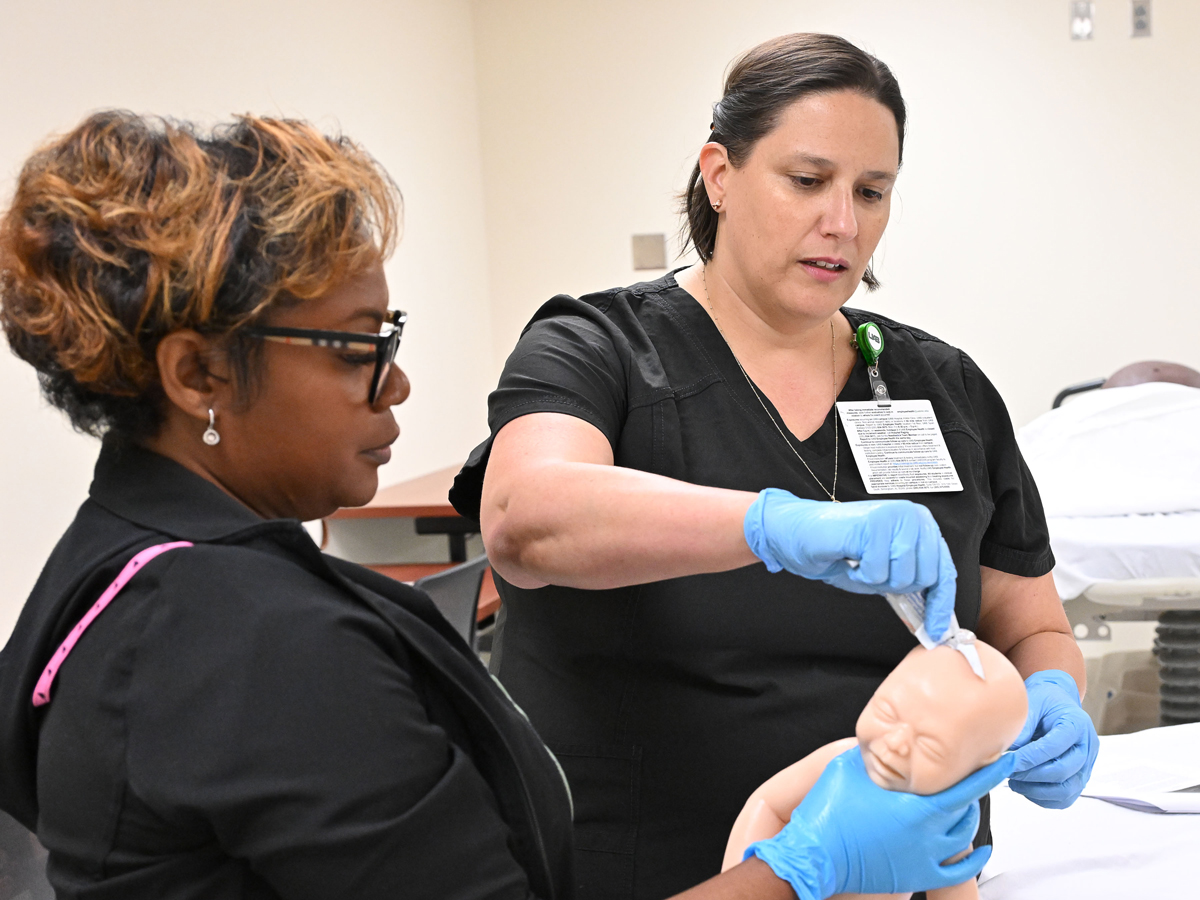
The University of Alabama at Birmingham School of Nursing Master of Science in Nursing Nurse-Midwifery Pathway has earned the maximum five-year initial accreditation from the Accreditation Commission for Midwifery Education. This recognition reflects ACME’s rigorous standards for teaching excellence and academic quality. As the only ACME-accredited nurse-midwifery education pathway in Alabama, this achievement marks a pivotal advancement for women’s health in the state and across the region.
“This full initial accreditation affirms the high standards of nursing education and excellence for which our School is internationally known and speaks to the strength of our MSN Nurse-Midwifery Pathway,” said Dean and Fay B. Ireland Endowed Chair Maria R. Shirey, PhD, MBA, RN, NEA-BC, ANEF, FACHE, FNAP, FAAN. “It reinforces our commitment to preparing nurse-midwives to help improve the health of women and children, advancing our mission to make a meaningful, positive impact on health outcomes in Alabama.”
Professor and Associate Dean for Graduate Clinical Education Aimee Holland, DNP, WHNP-BC, FNP-C, FAANP, FAAN (DNP 2012), said the accreditation reflects a strong team effort and a turning point for healthcare in state.
“The ACME accreditation milestone for the School’s MSN Nurse-Midwifery Pathway marks a significant step forward for the health of Alabama’s families by expanding access to high-quality women’s health, infant and maternity care, supporting better outcomes and strengthening the maternal-child health workforce statewide,” Holland said.
Alabama consistently ranks among the nation’s worst for perinatal outcomes, including high rates of low birth weight and preterm birth, according to the March of Dimes. Only about one-third of Alabama counties have adequate access to maternity care, leaving many women with limited or no local options. “Growing our nurse-midwifery workforce and integrating nurse-midwives into evidence-based interprofessional models of care, will be critically important for improving access to high quality maternity care across Alabama”, said Allison Shorten, PhD, RN, FACM, FNAP, FAAN, Executive Director of the School’s Women and Children Health Initiative (WACHI), and Senior Associate Dean for professional Development and Faculty Affairs. “Expanding opportunities for nurse-midwives to be fully embedded into our healthcare services, will ultimately contribute to improvements in perinatal outcomes so urgently needed in Alabama.”
The School relaunched the MSN Nurse-Midwifery Pathway in 2022 due to the increased statewide demand for highly qualified maternal-infant healthcare providers, more than a decade after closing its initial pathway. By educating nurse-midwives to manage obstetrical and gynecological care that makes up the reproductive health of women, as well as the care of their infants in the first days of their life, and to work collaboratively with physicians and other health professionals, the School is meeting a critical need for women of childbearing age and their infants across Alabama.
The first cohort of the newly re-established Nurse-Midwifery Pathway graduated in August 2024, expanding access across Alabama and beyond to comprehensive, team-based women’s health, pregnancy and infant care, said Elizabeth Muñoz, DNP, CNM, FACNM, assistant professor, interim director of the MSN Nurse-Midwifery Pathway and co-director of WACHI.
“Receiving initial accreditation through 2030 is the strongest outcome a program can achieve,” Muñoz said. “The momentum of our pathway, and the achievements of our students and graduates, inspire tremendous optimism. I am confident they will continue to help drive meaningful, long‑term improvements in maternal and infant health outcomes throughout Alabama.”
Nurse-Midwifery is one of the key initiatives of the School’s Women and Children Health Initiative, which encompasses all the School’s maternal and child health focused work across its teaching, research and practice missions. WACHI’s vision is to assure a future where women and children in Alabama are not only healthy but are thriving and achieving their highest potential. The School is collaborating with community partners to reach women and children in every corner of the state and are working together to build a highly educated and well-resourced nursing workforce, equipped and practice-ready to address our many challenges and to create solutions for a sustained healthcare workforce.
To this end, WACHI encompasses all the School’s maternal and child health focused work across its teaching, research and practice missions. This includes the Nurse-Family Partnership, MSN Nurse-Midwifery Pathway, Women’s Health Nurse Practitioner Specialty Track, Neonatal Nurse Practitioner Specialty Track, Pediatric Nurse Practitioner Specialty Tracks and the Graduate Nursing Education Primary Care Scholars; the School’s nurse-managed clinic at Wellhouse that provides health care to women who are escaping human trafficking and the School’s women’s health faculty practice at Cooper Green Mercy Health Services; a partnership with Birmingham charter school I3 Academy, which provides regular vision and hearing screenings and health assessments for students, along with health education events for families; and an initiative with Birmingham’s Titusville community, Booker T. Washington K-8 School and Sixth Avenue Baptist Church to reduce childhood obesity and its associated poor health outcomes in the Birmingham area, and a partnership with Birmingham City Schools, Pathway to Professional Nursing, housed at Huffman High School that is designed to increase adolescents’ exposure to the nursing profession.
For more on the Accreditation Commission for Midwifery Education, visit theacme.org.