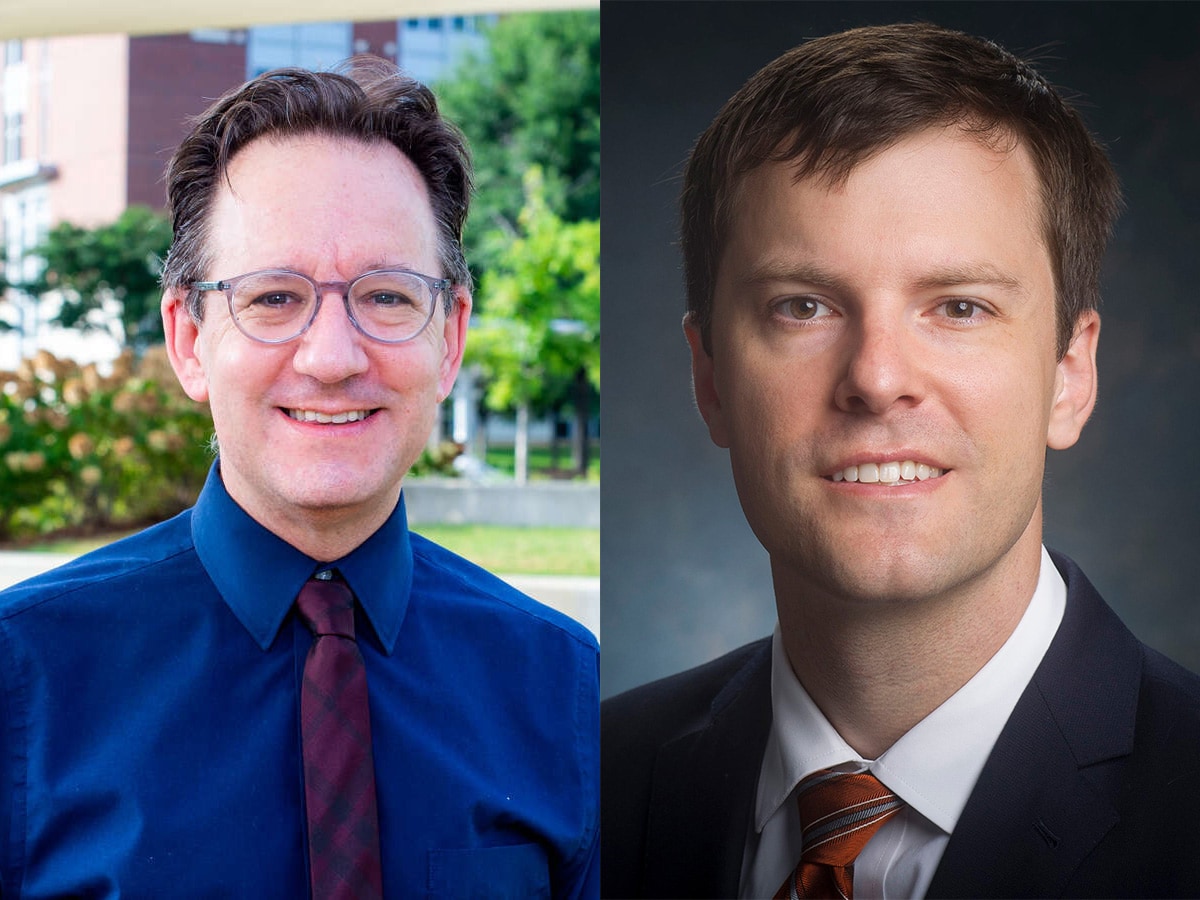
 Stefan Kertesz, M.D. and Kevin Riggs, M.D.People who have experienced homelessness receive more consistent primary care and rely less on emergency services when they visit specialized clinics designed specifically for their needs, according to new research from the University of Alabama at Birmingham.
The study found that homeless patients relying on tailored primary care clinics were more likely to see the same provider and needed fewer specialty and emergency visits.
Homelessness leads to fragmented health care because of barriers like transportation, needing to find a place to stay and stigma. Researchers from UAB’s Division of General Internal Medicine and Population Health, including Stefan Kertesz, M.D., and Kevin Riggs, M.D., examined how consistently patients stay connected with the same primary care provider. The investigators made their comparison within the Veterans Administration, while emphasizing that similar models also operate outside of the VA.
Their study compared two types of VA clinics: Homeless Patient Aligned Care Teams, or H-PACTs, which are tailored to meet the needs of homeless veterans; and mainstream Patient Aligned Care Teams, or PACTs, the standard VA primary care model.
Key Findings
- 65 percent of patients using H-PACTs achieved high continuity, compared to 58 percent in mainstream clinics
- They were 48 percent more likely to achieve “high” continuity scores
- They had 4.6 primary care visits/year vs. 4.0
- They had fewer specialty visits (6.2 vs. 7.9)
- They had fewer ED visits (1.0 vs 1.4)
The study found that veterans receiving care in clinics tailored for homeless individuals experienced better continuity of care. About 65 percent of these veterans consistently saw the same provider, compared to 58 percent in regular VA clinics. They also had more primary care visits — around 4.6 per year versus 4.0 — and were less likely to need emergency care.
Kertesz says primary care works best when patients regularly see providers who know them.
“This is true across the board, for all patients. Even for you and me,” Kertesz said. “Think about a family member with multiple long-term conditions and imagine them having to go see a new doctor every time they need follow-up. Even with a medical record, the doctor or nurse practitioner who has seen them before has a much greater likelihood of understanding the impact of the last decisions made, and hearing what they have to say. In the scientific literature, better continuity is associated with fewer hospitalizations and emergency department visits.”
Continuity can be especially challenging for people facing homelessness, poverty or unreliable transportation. Kertesz says their lives are unpredictable, making it harder to keep appointments or build trust with a care team. Even after finding housing, many still struggle with logistics or distrust of the health system.
When continuity breaks down, the impact is also greater for patients with complex medical, mental health or social challenges. Repeating long, sensitive histories to new providers can be burdensome and can lead to worse consequences.
Kertesz says these clinics shifted care around, while actually making care more efficient.
What makes tailored clinics different
Tailored primary care programs for people experiencing homelessness date back to the 1980s, but many lost specialized features over time. In 2012, the Veterans Administration launched H‑PACT clinics inspired by the original models. Because veterans could choose between these specialized clinics and mainstream VA clinics, researchers were able to compare the models directly.
H‑PACTs do not simply provide medical care — they also offer integrated supports such as food, clothing and addiction services. These additional resources appear to improve veterans’ engagement with their care.
“What we have seen is that food and clothing play two distinct roles,” Kertesz said. “They meet an immediate need, but they also send a powerful message: ‘You are precisely the patient we want to serve here.’ That matters deeply to people who have often felt unwelcome in other health care settings.”
A model that could benefit other vulnerable populations
Riggs describes the study as evidence that tailoring clinical environments to the needs of specific groups improves one of primary care’s most important goals: continuity.
“Any time a clinic decides to set up its services, its personnel and its space to specifically accommodate the population they most wish to serve, that is ‘tailoring,’” Kertesz said. “Tailoring services should look different, and it should be different, if one is serving youth coming out of foster care or serving poor farmers or serving people with addiction or serving elderly people or people who are homeless.”
He says that helps reassure patients who have often felt unwelcome in other health care settings.
The study was funded by the U.S. Department of Veterans Affairs.