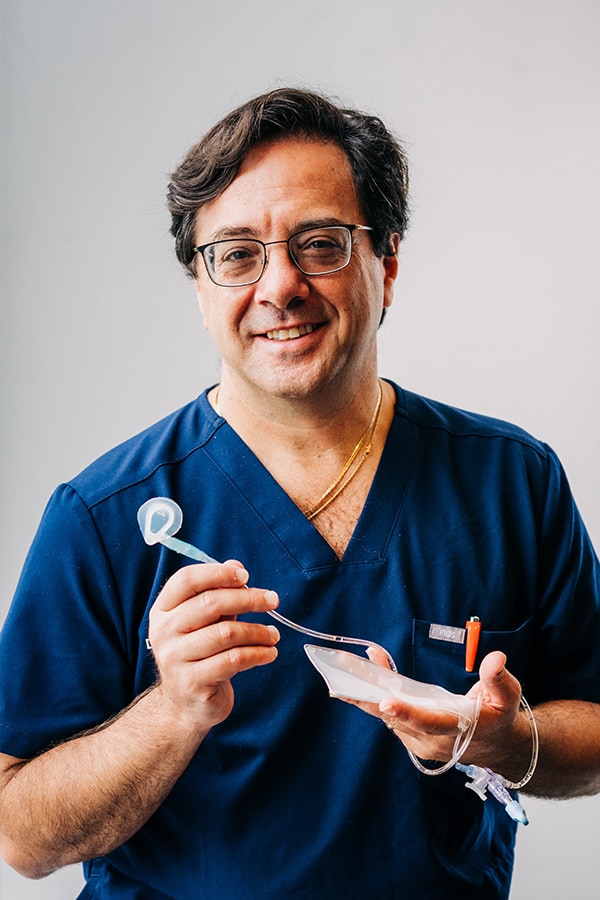
 David Askenazi, M.D.
Researchers at the University of Alabama at Birmingham are developing innovations and technology that support kidney health through pediatric medical devices, surgical innovation and microbiome-based therapies.
Recent innovations by faculty at the UAB Marnix E. Heersink School of Medicine, supported by the Harbert Institute for Innovation and Entrepreneurship, are designed to transform how kidney conditions are monitored, diagnosed and treated.
Expanding tools for kidney care
David Askenazi, M.D., professor in the Division of Pediatric Nephrology and W. Charles Mayer Endowed Chair in Pediatric Nephrology, has developed two devices to address gaps in kidney and urologic care.
The first device, Zorro-Flow, is a noninvasive external urine collection device for small children and neonates. Collecting urine in neonates has long been a challenge due to their size, making traditional methods invasive or unreliable.
“In small children or neonates, it is extremely difficult to collect urine,” Askenazi said. “Recognizing that the size of the urethra in a female neonate is the size of a hair, it’s hard to put in a catheter.”
Developed through an iterative process using 3D-printed prototypes, the device is now FDA-registered and in use at UAB and another academic children’s hospital in the United States, with plans to expand nationwide.
Askenazi is also developing the Fluid Aviator, a system designed to simplify how clinicians manage fluid balance in critically ill patients. Current approaches require time-intensive tracking and complex calculations, often leaving room for error.
“The status quo is very complicated,” Askenazi said. “It demands a lot of nurses’ time, and providers are asked to do complex calculations.”
The Fluid Aviator automatically captures fluid data, calculates cumulative balance and allows providers to adjust treatment in real time, shifting care from a reactive to a proactive approach.
“We will prevent harm due to patients’ being fluid over- or under-loaded,” Askenazi said. “And it will save countless hours from the nursing perspective.”
 Kyle Wood, M.D.
Enhancing precision in kidney procedures
Kyle Wood, M.D., associate professor in the Department of Urology, is developing an ergonomic assist device designed to improve ureteroscopy, a common minimally invasive procedure used to diagnose and treat kidney stones, with Andres Morales, instructor at the UAB School of Engineering’s Department of Mechanical and Materials Engineering, and other product developers.
During ureteroscopy, surgeons use a flexible scope equipped with a camera to navigate through the urinary tract to locate and treat stones. While the technology inside the scope has advanced significantly, Wood says the external surgical environment has not kept pace.
“Surgeons are often forced to manage delicate equipment in crowded spaces, sometimes resting scopes on the patient or relying on assistants to hold them,” Wood said.
This can lead to equipment damage, inefficiencies and added physical strain on surgeons over time.
Wood’s device, known as ScopeAssist, acts as a “third arm,” allowing surgeons to stabilize and control the scope hands-free when needed. The system attaches to existing equipment and moves with the surgeon, offering flexibility while reducing fatigue.
By securely holding the scope in place, the device helps prevent drops, maintains camera positioning and streamlines workflow during procedures.
“ScopeAssist provides a continuous means of securing the scope throughout the procedure,” Wood said.
The technology improves organization in the operating field by managing cables and allowing surgical tools to remain within reach, creating what Wood describes as a more efficient “surgical cockpit.”
Beyond convenience, the device has the potential to improve patient outcomes by reducing procedure time, minimizing contamination risks and decreasing reliance on additional staff.
As kidney stone cases continue to increase nationwide, such innovations are increasingly valuable.
“The volume of procedures has grown significantly, and there is a need for solutions that improve both efficiency and safety,” Wood said.
 John Knight, Ph.D.
Targeting kidney stones through the microbiome
John Knight, Ph.D., a tenured associate professor in the UAB Department of Urology and inaugural holder of the John R. Burns, M.D., and Dean G. Assimos, M.D., Endowed Professorship, is exploring new ways to prevent kidney stones by studying how the body processes oxalate.
His research focuses on calcium oxalate stones, the most common form of kidney stone, and how they develop.
“The overall goal of our research is to investigate novel strategies to reduce the risk of calcium oxalate kidney stone formation,” Knight said.
Knight’s interest in the field began during his postdoctoral training, where mentorship helped shape his research direction.
“I was fortunate enough to have caring, thoughtful mentors who inspired me to focus my research on kidney stone disease,” he said.
A key area of his work examines how oxalate is regulated in the body and how that process might be influenced to prevent stone formation. One promising avenue involves Oxalobacter formigenes, a naturally occurring gut bacterium that helps break down oxalate.
“Increasing our knowledge of factors that influence the excretion of urinary oxalate may lead to novel approaches to reduce risk,” Knight said.
In addition to microbiome research, Knight has contributed to studies targeting enzymes in the liver that play a role in oxalate production. That work has supported the development of RNA interference therapies now approved to treat Primary Hyperoxaluria Type 1, a rare genetic disorder.
As kidney stone cases continue to rise, particularly in the southeastern United States, Knight emphasizes the need for continued research.
“Incidence of kidney stone disease is increasing,” he said. “There is a need to investigate risk factors and develop approaches to decrease risk.”
Looking ahead, Knight hopes to see more affordable treatments and greater interest in kidney research among future scientists.
“I hope cheaper drugs are developed for primary hyperoxaluria, and I hope more young trainees become interested in pursuing research in benign kidney diseases,” Knight said.