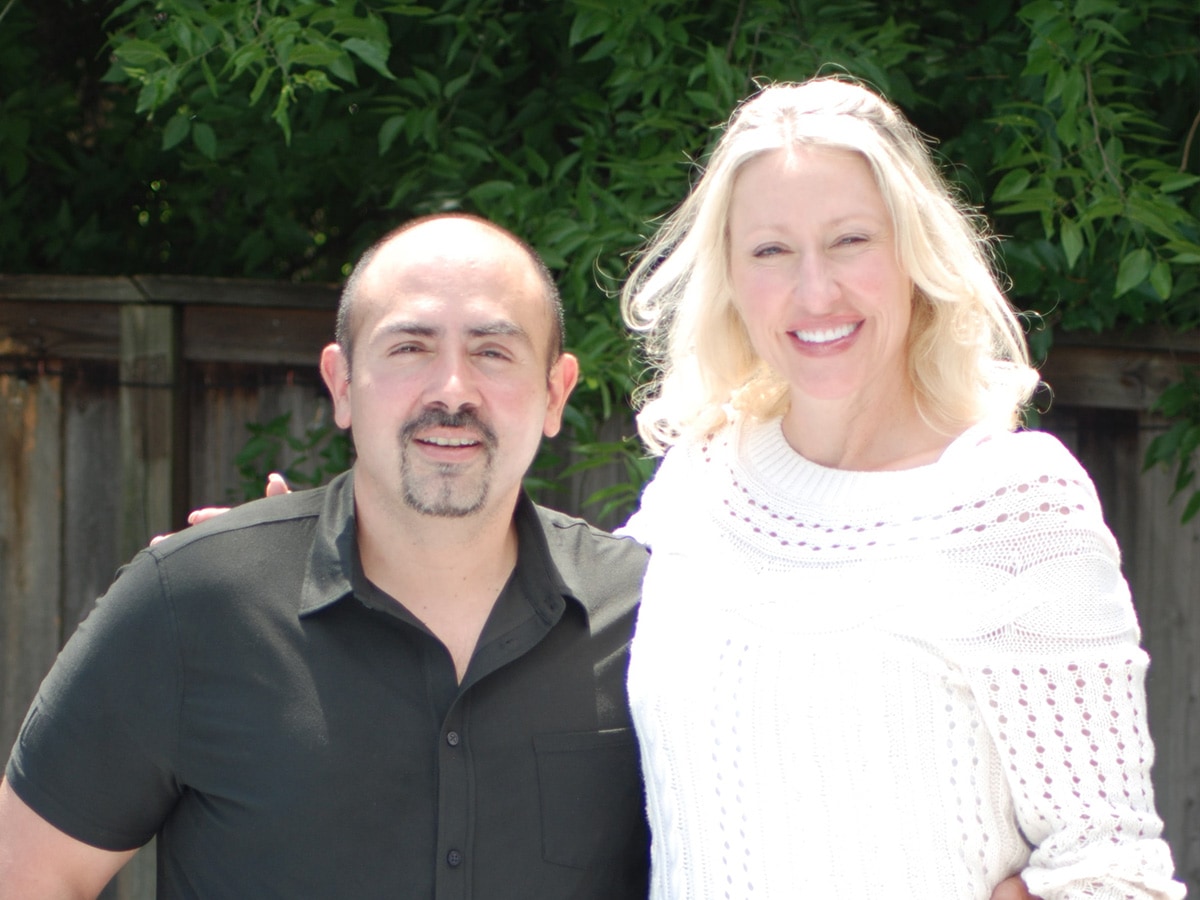
 Edwin and Melissa VillarrealFor a healer, experiencing a life-threatening illness themselves can be unthinkable.
Until 2024, Edwin Villarreal, M.D., an Alabama hospitalist, had only ever dealt with common colds himself. That changed when he was diagnosed with hemophagocytic lymphohistiocytosis, commonly known as HLH, an aggressive and often fatal condition that was driven by an underlying lymphoma. Without intervention, his prognosis was 100 percent mortality.
As a physician himself, Villarreal trusted the comprehensive team at the University of Alabama at Birmingham O’Neal Cancer Center for his care. Thankfully, he achieved the unachievable ––he has been cancer-free for a year and is living a beautiful life with wife Melissa, son Ian, and his pets Ellie, Jax, Tax and Lexi.
Life-changing diagnosis
Villarreal, a graduate of the UAB Marnix E. Heersink School of Medicine’s Montgomery campus, has been in good health throughout his life, doing all the right things like exercising and eating a nutritious diet.
In January 2024, he started experiencing recurring fevers, weight loss and chills after working out, which got him worried.
“In mid-May, I told Melissa, ‘hey, I think we need to go to the hospital. Something is off; I’m getting fevers daily. I’m losing weight. I mean, not feeling good,’” Villarreal said.
In the emergency room, a CT scan uncovered a larger-than-usual spleen. Hearing this, Melissa, who Villarreal calls his “superhero” and “bodyguard,” told him, “Look, have your day of rest today, but tomorrow we are going to UAB.”
Although he had spent years referring patients to UAB, Villarreal never imagined becoming a patient himself.
“I knew that, when I got really sick, UAB is where I needed to go,” Villarreal said. “That’s where you go if you need answers. The right answers.”
Risk versus reward
In August, Villarreal was diagnosed with HLH when hospitalized at UAB. The inpatient team consulted Gaurav Goyal, M.D., associate professor in the Division of Hematology and Oncology, who specializes in rare disorders like HLH.
“HLH is basically a condition where your immune system is harming you,” Goyal said. “We all get a little bit of fevers, which are protective. A little immune reaction is good. But in HLH, immunity is revved up so much that organs start failing.”
Goyal and the hematology team at UAB told Villarreal that, without action, he would not survive.
“The blood count was so low that it was risky to do a spleen biopsy,” Goyal said. “We couldn’t do chemo either without knowing the cause of HLH.”
With the spleen identified as the likely source of the problem, Goyal consulted Sushanth Reddy, M.D., a surgical oncologist specializing in pancreatic and liver diseases.
Reddy says the standard approach to HLH is to treat the underlying lymphoma with chemotherapy. In Villarreal’s case, that was not an option.
“He was too ill to even get to that point,” Reddy said. “The only way we foresaw his surviving was by taking the spleen out.”
The same night, a multidisciplinary team at UAB met to discuss the gravity of the situation, evaluating the risk versus reward.
“If we only considered his numbers, we would not do a splenectomy because the mortality rate was 20 percent,” Goyal said. “However, when the mortality without doing the procedure is 100 percent, the risk-benefit ratio changes quite a bit.”
The odds of survival
The doctors discussed the complexity of the situation with Villarreal clearly and honestly.
“Dr. Reddy told me that, if we don’t do this, you probably have a week or two weeks left, if anything,” Villarreal said. “The problem is, if I take you to the operating table, you may not survive either because you may bleed out.”
Villarreal showed remarkable resilience and faith and decided to go into surgery the next morning, hoping for a miracle. Reddy took the spleen out and watched a miracle unfold over the next 12 hours.
“All of his numbers got better almost instantly after getting that spleen removed,” Reddy said. “It was remarkable to watch.”
The removal of the spleen improved inflammation markers and allowed for a diagnosis of diffuse large B-cell lymphoma, an aggressive lymphoma that was the likely cause of the HLH. For treatment, Villarreal needed chemotherapy.
Starting chemotherapy with someone having an open abdomen was unheard of, but so was Villarreal’s case. The doctors began cautiously while continuously monitoring his response. As Villareal stabilized, the team escalated to full-dose chemotherapy.
The results exceeded expectations. Villarreal made a full recovery.
“Edwin finished therapy like a champ, with virtually no side effects,” Goyal said. “His inflammation markers have remained down, and we’re very hopeful the lymphoma will not return.”
One year later, Villarreal continues to do well and has returned to daily life. Reflecting on his experience, he points to the strength of coordinated care and the support system needed to beat cancer.
“I will always have UAB and all its staff in my heart. It is a top-notch facility, and I have no hesitation recommending it. I feel so proud to be an internal medicine physician graduate from UAB,” Villarreal said.
To overcome cancer, one needs doctors, family, friends and faith. “It all comes together,” Villarreal said.
“My parents and brother came from Florida, and my cousin flew from New York to comfort and support me,” Villarreal said. “My cousin, who is also my pastor, was always on video calls with me from Colombia, providing prayers for me and spiritual support to all my family. Dr. Martin Rodriguez from Infectious Diseases was my attending when I was in training and took the time to talk to my family and parents when I was really ill.”
A model of comprehensive care
For Goyal, Villarreal’s case highlights what sets comprehensive cancer centers apart.
“It goes beyond guidelines and standard treatment plans,” Goyal said. “There are immeasurable benefits that come from having a full team working together on complex cases. This team includes hematologists, oncologists, surgeons, pathologists who are experts in diagnosing such rare conditions and ICU team that can help manage critically ill patients.”
Access to clinical trials is another key advantage at the O’Neal Cancer Center, Alabama’s only NCI-designated cancer center. Following Villarreal’s case, UAB launched a clinical trial focused on HLH and includes this case in clinical training for residents.
“This is one story,” Goyal said. “But it has expanded options for patients across the state. Edwin’s case truly shows what’s possible when you have that level of collaboration under one roof.”