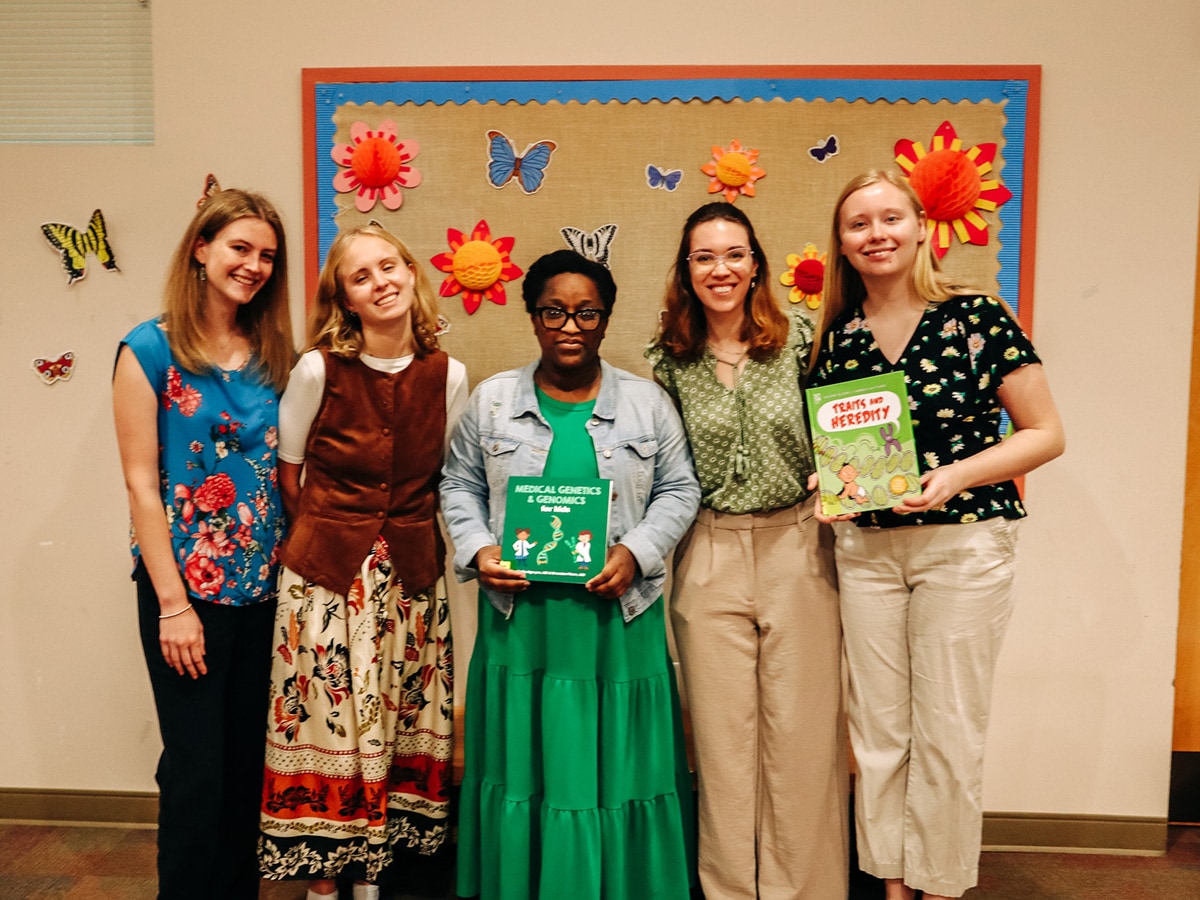
 UAB Genetic Counseling students partnered with Lister Hill Library to engage children and families in hands-on genetics education while highlighting the program’s commitment to community outreach and health literacy.Students from the University of Alabama at Birmingham’s Genetic Counseling program recently partnered with Lister Hill Library to present their interactive Hands-on Exploration, Analysis, Learning, Technology and Health, or H.E.A.L.T.H., Lab at Albert L. Scott Library in Alabaster, providing local children with an engaging introduction to science and health concepts.
“A central part of our role as genetic counselors is translating complex information into something patients and communities can understand,” said Emily Sandlin, a second-year student in the Genetic Counseling program.
Sandlin says the program was developed through a collaborative process, with students drawing on their individual experiences and motivations for entering the field. She notes that genetic counseling extends beyond clinical care to include public engagement, with an emphasis on improving understanding among both patients and healthcare professionals.
“All of us found our way to genetic counseling through different experiences,” said Caroline Nelson, a first-year student who plans to bring the program back in the fall semester. “Having the opportunity to introduce this field to the next generation and make it more accessible is incredibly meaningful.”
For Sandra DeMaria, participating in the program represented a full-circle moment. Raised in a military family, DeMaria spent part of her childhood in Clanton, Alabama, where visits to the Albert L. Scott Library were a regular part of her early life.
“I have a big passion for accessibility and education for rural communities because of some of the health and education inequities they can have,” DeMaria said. “I was born with a birth difference, and so were both of my parents. I grew up having to learn about my own birth difference and how to advocate for myself.”
DeMaria says those early experiences prompted questions about her health and family history — questions she was unable to fully explore until relocating to a larger city with greater access to genetic services and educational resources. That access ultimately influenced her decision to pursue a career in genetic counseling, with a focus on improving health education and access for underserved populations.
DeMaria graduated from the program on Friday, May 1.
The H.E.A.L.T.H. Lab program featured four interactive learning stations designed to introduce foundational genetics concepts to children and their families. The session began with an overview of genetic traits and DNA, followed by hands-on activities that used tactile materials, including colored pompoms, to demonstrate how traits such as hair color, texture and eye color are inherited. Interactive elements, including imaginative “superpower” traits, helped reinforce key concepts in an age-appropriate way.
The event also incorporated curated reading materials on genetics, provided by library staff, to encourage continued learning beyond the program.
Megan Bell, assistant professor and consumer health and community engagement librarian at UAB’s Lister Hill Library, collaborates with academic departments across campus to develop community-facing programs that promote health literacy and lifelong learning.
The Genetic Counseling program emphasizes experiential learning and community engagement, providing students with opportunities to apply their training in real-world settings. Initiatives such as H.E.A.L.T.H. Lab support the program’s mission to advance public understanding of genetics while fostering professional development and service among its students.