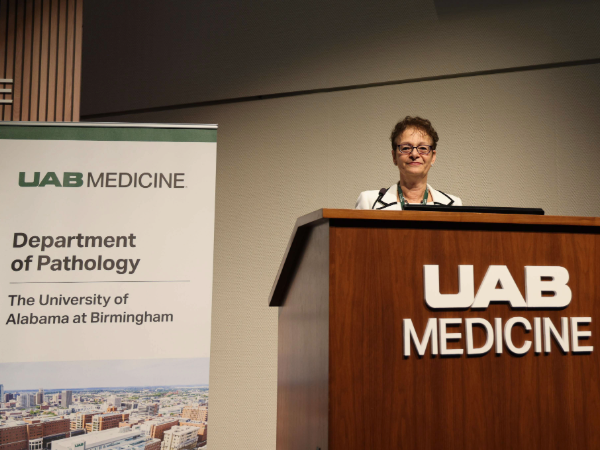
 Cristina Magi-Galluzzi, M.D., Ph.D., Robert and Ruth Anderson Endowed Chair in Pathology, presented the 2026 State of the Department on Wednesday, August 19.
"Our mission is to provide first-class patient care, high standards for medical education, and innovative scientific research to advance personalized clinical medicine, while leaving a positive impact on patients, faculty, staff, and trainees," said Magi-Galluzzi.
The department's success depends on a strong team that brings different expertise, perspectives, and strengths together around a common vision. Magi-Galluzzi made sure to thank the people behind the mission, especially the expansive leadership team made up of division directors, vice chairs, section heads, and laboratory medical directors, who translate the department's vision into action. She welcomed the 11 new faculty who have joined our team since January, and emphasized the importance of recent recruitment efforts.
"The practice of pathology is evolving, and with it, the role of our department," Magi-Galluzzi said. "We are moving from pathology as the discipline that defines disease, to pathology as a discipline that helps define what comes next for the patient."
Magi-Galluzzi emphasized the need for specialization, one of the tasks she was recruited to UAB to implement in surgical pathology. The more complex medicine becomes, she said, the more important expertise becomes. Precision medicine requires precision pathology, which requires deep knowledge of specific diseases, organ systems, and technologies.
While Magi-Galluzzi discussed the role of pathologists at UAB, a video was shown to show the complex process of a pathology specimen reaching its diagnosis. The journey of a specimen relayed the amount of laboratory professionals, trainees, and attendings involved to reach timely and accurate patient diagnoses.
Of an estimated 150,000 annual hospital visits, 90% of patients will require some form of pathology service. Clinical volume data was shared to reiterate the significance of this fact. UAB Hospital Laboratories and UAB Pathology CLIA-certified reference laboratories were featured as important pieces of the Division of Laboratory Medicine operation.
The Division of Genomic Diagnostics and Bioinformatics was featured for its real-time clinical trial matching algorithm. The Division of Neuropathology was featured for its extensive collaborations, fundamental research, and leadership in the UAB Alzheimer's Disease Research Center Neuropathology Core. The Forensics Division was featured to showcase its new facility's ribbon cutting ceremony held last year in conjunction with the Jefferson County Coroner and Medical Examiner's Office.
"The power of pathology extends beyond diagnosis, and transplantation is perhaps one of the clearest examples of where pathology directly intersects with life-changing clinical decisions," Magi-Galluzzi said. "Our pathologists in the Divisions of Anatomic Pathology, Women's Health, Laboratory Medicine, and Neuropathology play an essential role throughout the transplant journey."
Magi-Galluzzi emphasized that the commitment to diagnostic excellence does not stop at the walls of our academic medical center. Through the Community Practice Pathology Program, the expertise of UAB Pathology is extended to patients and providers throughout many Alabama communities. A tangible example of this commitment is the opening and celebration of the new cytology lab in Montgomery, the Robert B. Adams Laboratory.
"Clinical excellence defines how we care for patients today," said Magi-Galluzzi. "Research defines how we improve the care we deliver tomorrow."
Magi-Galluzzi highlighted the department's extramural research funding, which totals more than $20 million annually, and shared its No. 12 national ranking in the 2025 Blue Ridge ranking for NIH funding. She congratulated our top 3 funded principal investigators, Drs. Sixto Leal, Ming He, and Casey Weaver, for their being ranked in the top 100 pathology investigators nationally. Magi-Galluzzi discussed top research stories in the news from the past year.
"Our mission does not end with discovery," Magi-Galluzzi said. "As an academic department, we have an equally important responsibility to educate, mentor, and inspire the next generation of pathologists."
In the sphere of education, Magi-Galluzzi highlighted the department's residency and fellowship programs, including their faculty and trainee leadership teams, the recently held Outgoing Reception to honor graduating trainees, faculty teaching contributions and publications by division for 2025, and RaCE4Path, a program focused on growing the pipeline of UAB Heersink School of Medicine MS1 students into pathology as physician-scientists.
In an effort to establish where the department has been, where it is now, and where it is going, Magi-Galluzzi discussed the journey to digital pathology, an initiative launched in 2024. Her vision is to build a pathology department that is increasingly digital, data-driven, collaborative, and innovative, while remaining firmly grounded in the expertise and judgement of pathologists.
"This evolution presents an extraordinary opportunity for our department," said Magi-Galluzzi. "Digital pathology will be an important foundation for the future of pathology. It will enable us to connect morphology with quantitative analysis, molecular information, artificial intelligence, and other clinical data in ways that can transform diagnosis, education, research, and patient care."
The presentation concluded by recognizing important faculty accolades over the past year, celebrating the importance of department wellness initiatives, and thanking the administrative professionals who support the mission of the Department of Pathology behind the scenes each day.