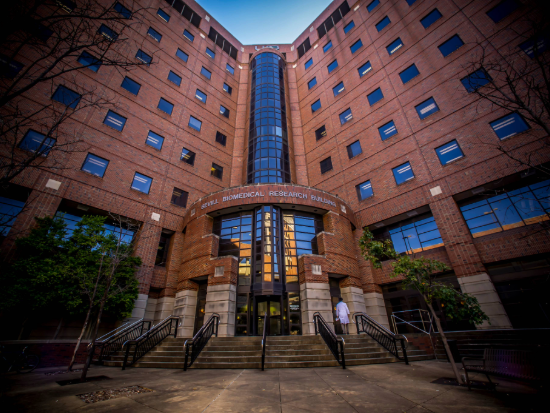
 The UAB Department of Microbiology achieved a significant national ranking in the 2025 Blue Ridge Rankings, placing No. 15 among microbiology departments nationwide.
In addition, five faculty members in the Department of Microbiology ranked among the top 18 percent of principal investigators (PIs) in the Microbiology/Immunology/Virology category for individual funding. They include:
- Frances Lund, Ph.D: No. 33
- J. Victor Garcia-Martinez, Ph.D.: No. 53
- Michael Niederweis, Ph.D.: No. 147
- Adrie Steyn, Ph.D.: No. 194
- Carlos Orihuela, Ph.D.: No. 206
The Blue Ridge Rankings evaluate departments and PIs across the country based on NIH research funding, a key measure of academic research activity.
“This recognition in the 2025 Blue Ridge Rankings reflects not only the collective excellence and collaboration of our faculty, but also the trajectory of what we are building together,” said J. Victor Garcia-Martinez, Ph.D., professor and chair, Charles H. McCauley Endowed Chair in the Department of Microbiology. “Achieving a top-15 national ranking—and seeing multiple investigators among the nation’s most highly funded scientists—signals the growing impact of our science and our shared vision to drive discovery, redefine what is possible, and translate innovation into lasting advances in human health.”
The Department of Microbiology leads a robust multidisciplinary research enterprise across five broad yet interconnected areas: microbial pathogenesis, immunology, virology, structural biology and biophysics, and cancer. Together, these programs underpin the department’s strong national standing in extramural research support.
“The ranking is founded on a decades-long history of cutting-edge biomedical research conducted by talented and dedicated faculty, trainees, and staff,” said Allan Zajac, Ph.D., professor and Vice Chair for Strategic Planning, Finance, and Research in the Department of Microbiology. “This exemplifies the hard work and accomplishments of our department. We attract high-quality researchers from across the globe, and our goal is to provide an environment where science can thrive.”
Learn more about research programs in the Department of Microbiology.
Microbial Pathogenesis
The Microbial Pathogenesis program focuses on understanding how bacterial, fungal, and parasitic pathogens function, evolve, and cause disease. Investigators study host–pathogen interactions, microbial virulence strategies, antibiotic resistance, and microbial adaptation with the goal of identifying new targets for prevention and treatment of infectious diseases. This research addresses both emerging pathogens and globally significant infectious threats.
Immunology
Research in Immunology at UAB explores the fundamental mechanisms that govern immune cell development, regulation, and dysfunction. Faculty investigate how immune responses are initiated, maintained, and dysregulated in infection, autoimmunity, inflammation, and cancer. This work informs vaccine development and immunotherapeutic strategies and builds on UAB’s longstanding strength in basic and translational immunology research.
Virology
The Virology program examines viral evolution, replication, and interactions with host cells and the immune system. Researchers study a broad spectrum of medically important viruses, with an emphasis on discovering novel antiviral strategies, advancing vaccine platforms, and developing viral vectors for therapeutic use. This program contributes significantly to UAB’s research efforts in emerging viral diseases and pandemic preparedness.
Structural Biology & Biophysics
The Structural Biology and Biophysics program applies advanced structural, computational, and biophysical methods to define molecular mechanisms underlying infection, immune dysfunction, and cancer. By revealing the structure and dynamics of proteins and macromolecular complexes, this research provides critical insights that enable rational drug design and therapeutic innovation.
Cancer
The department’s Cancer research program integrates microbiology, immunology, and molecular biology approaches to understand the mechanisms driving cancer development and progression. Faculty conduct highly collaborative basic and translational studies aimed at identifying new biomarkers, diagnostics, and treatment strategies across a range of tumor types, often in partnership with clinicians and cancer-focused research centers.
A collaborative research environment
A defining strength of the UAB Department of Microbiology is its highly collaborative research culture. Faculty and trainees work closely with investigators across campus and within established interdisciplinary centers, including programs in microbial pathogenesis and genetics, immunology, virology, HIV/AIDS research, tuberculosis research, and the UAB O’Neal Comprehensive Cancer Center. These partnerships enhance scientific impact and accelerate translation from discovery to clinical application.