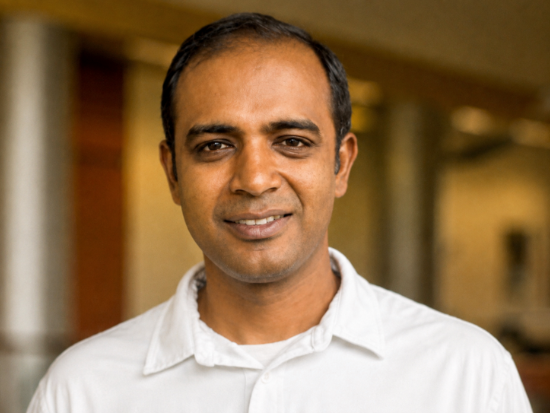
 Behind every biomedical breakthrough that reaches a patient is a story of translation done right. The communications team sat down with Palaniappan Sethu, Ph.D., professor in the Department of Biomedical Engineering, to discuss the new Undergraduate Certificate in Translation of Biomedical Innovation to Clinical Practice and how it will give students the tools to carry ideas the full distance, from unmet need to patient impact.
Bridging the gap in biomedical education
According to Sethu, the new certificate was born out of a recognition that technical skill alone isn't enough to move an innovation into clinical use.
“Clinical translation is a complex process, and individuals engaged in this process need to have a comprehensive understanding of the entire translational pathway,” said Sethu.
That pathway includes “identifying an unmet clinical need and designing and validating solutions that meet design, financial, legal, and regulatory constraints” to successfully achieve clinical translation.
The certificate is intended to enhance a student's primary degree, not replace it. Sethu believes that pairing this certificate with a degree in engineering, basic science, business, or medicine will give students interested in clinical innovation the foundation they need to fully navigate this complex process.
Stopping innovations from stalling out
Translation is fundamentally about more than technical performance. It's about whether an innovation can truly take root in the real world, where clinical, regulatory, and human factors matter just as much as the underlying science.
“Translation means addressing a clinical problem and providing benefit to patients while also satisfying the needs of other stakeholders,” said Sethu. “Many promising innovations stall, not because the solution is bad, but because the translational questions were not addressed as part of the process.”
This certificate is built to close that blind spot. It walks students through the entire clinical translation continuum, equipping them to address these questions as they work toward developing a product that can succeed in the clinic.
Open to all who seek solutions
When asked if this certificate was designed specifically for researchers, clinicians, engineers, or entrepreneurs, Sethu’s answer was refreshingly simple.
“This certificate is designed for any individual with an interest in clinical translation,” said Sethu.
Regardless of a student’s background, this certificate offers a shared framework for understanding how innovation moves from concept to reality, giving every student a common language for how ideas really reach patients.
No single hurdle stands alone
Regulatory hurdles, funding gaps, and industry partnerships are all familiar roadblocks in biomedical innovation, but Sethu was quick to point out that no single obstacle should be treated as an afterthought.
“The certificate emphasizes that all aspects of the process, including biodesign, commercialization, regulatory and legal issues are equally important and need to be considered to ensure successful clinical translation,” said Sethu.
Rather than tackling these challenges after coming up with a working solution, students learn to weigh them together and consider them as constraints during product development.
Where clinicians and engineers meet
At the heart of the certificate is the idea that clinical translation can't happen in a silo.
“Clinicians are important stakeholders in this process and play a critical role in the needs finding process to establish needs statements and needs specifications,” said Sethu.
Engineers depend on clinicians to properly define problems, and that collaboration keeps the technologies students develop grounded in genuine clinical needs, not just clever engineering exercises.
Success measured by impact
For Sethu, success isn't merely measured by a finished prototype or a completed course of study.
“Success will ensure that biomedical innovators who obtain this certificate clearly understand the clinical translation process and pursue designs that not only solve problems but can be successful from a business and regulatory perspective as well, ensuring that needs of patients are met,” said Sethu.
The Undergraduate Certificate in Translation of Biomedical Innovation to Clinical Practice reflects the Department of Biomedical Engineering’s broader commitment to preparing students to move seamlessly between the lab, the clinic, and the marketplace. For students who want their ideas to leave the classroom and change lives, this certificate offers a clear roadmap for making that happen.