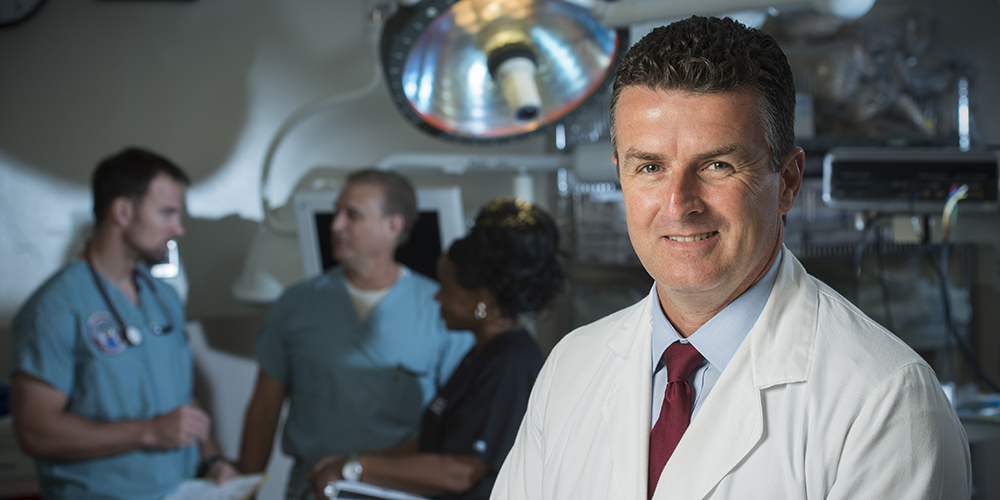
About the Center for Injury Science
The UAB Center for Injury Science (CIS) brings together clinicians, scientists, methodologists, and research professionals with a shared goal: to improve outcomes following injury and other time-critical conditions through better science, better systems, and better care.
Founded in 1999, CIS has grown into a multidisciplinary research center spanning the full continuum of injury care—from the scene of injury and prehospital environment through emergency resuscitation, definitive treatment, critical care, recovery, and rehabilitation.
Our work ranges from understanding the biological response to severe injury to testing new treatments in large multicenter clinical trials; from studying how trauma systems deliver care across entire populations to synthesizing evidence into clinical guidelines.
What connects these activities is a focus on research that can ultimately change care and improve outcomes for patients.
Research Across the Continuum of Injury Care
Injury is not a single disease, and improving outcomes requires more than one type of research. CIS therefore takes a broad, multidisciplinary approach.
Our investigators study:
Novel interventions in emergency, prehospital, and acute care, including treatments for hemorrhage, traumatic brain injury, burns, and other time-critical conditions.
Trauma systems and care delivery, including access to trauma care, rural and prehospital care, telehealth, health disparities, and patient outcomes.
Basic and translational science, including the biological responses to hemorrhage, shock, and resuscitation, with particular emphasis on endothelial dysfunction, coagulation, and organ injury.
This breadth allows us to approach important clinical problems from multiple perspectives, while creating opportunities for discoveries in one area to inform research in another.
From Discovery to Better Care
Our research programs are connected by a common translational pathway:
Clinical problem → scientific question → discovery → evaluation → implementation → improved care
A question observed at the bedside may lead to a laboratory investigation of its underlying biological mechanism.
A systematic review may identify an important gap in evidence that becomes the basis for a clinical trial.
A successful intervention may raise a new question: how can it be delivered effectively to patients living hours from a major trauma center?
And a large clinical trial can simultaneously provide biospecimens that allow scientists to investigate why patients respond differently to treatment.
By bringing these capabilities together within one Center, CIS aims to shorten the distance between an important clinical question and an answer that changes care.
Clinical Trials
CIS has developed particular expertise in the design, management, and conduct of complex and time-critical clinical research.
Our investigators lead and participate in multicenter trials involving traumatic hemorrhage, blood products, traumatic brain injury, burns, medical devices, drugs and biologics, and other emergency interventions.
These studies are supported by an experienced professional research team that includes nurse Trial Managers, Clinical Research Coordinators, regulatory and financial specialists, and a Research Assistant Program providing research coverage 24 hours a day, 365 days a year.
Although injury science remains central to our mission, this infrastructure also supports investigators and clinical trials across UAB.
Advancing Emergency Care Research
Some of the most important questions in medicine arise when patients are critically ill or injured and treatment cannot wait.
CIS has particular expertise in research conducted under Exception from Informed Consent (EFIC), which allows carefully regulated research to be performed in specific life-threatening emergencies when prospective informed consent is not possible.
Our work has extended beyond conducting EFIC trials to developing new approaches to the community consultation and public disclosure required for them, using interactive and digital methods to make engagement more scalable, measurable, and reproducible.
At the same time, we strongly support the right of individuals to choose not to participate in emergency research and provide mechanisms for members of our community to communicate that choice.
A Multidisciplinary Center
Complex problems require expertise from multiple disciplines.
CIS brings together trauma and acute care surgeons, emergency physicians, intensivists, anesthesiologists, rehabilitation specialists, epidemiologists, biomedical engineers, basic scientists, biostatisticians, health services researchers, methodologists, and other investigators.
They work alongside an experienced professional research team responsible for clinical trial management, research coordination, regulatory affairs, community engagement, data collection, research administration, and study operations.
Our collaborations extend throughout UAB and to academic institutions, research networks, government agencies, industry partners, EMS systems, healthcare organizations, and investigators across the United States and internationally.
Civilian and Military Injury Research
Many of the challenges encountered in civilian trauma care are shared by military medicine: uncontrolled hemorrhage, traumatic brain injury, prolonged transport, limited resources, and the need to deliver effective treatment as early as possible.
UAB has a longstanding military-civilian partnership, encompassing clinical training, research, and collaboration with the U.S. military, including Air Force Special Operations Surgical Teams, Air Force Pararescue personnel, and Army Special Operations medics.
CIS investigators conduct research relevant to both civilian and military trauma care, particularly in prehospital treatment, hemorrhage and resuscitation, traumatic brain injury, diagnostics, and care in austere environments.
This partnership creates important opportunities for the bidirectional translation of knowledge and innovation—from battlefield to civilian trauma system, and from civilian research back to military medicine.
Training the Next Generation
Research is also an educational mission.
CIS provides research opportunities for undergraduate students, medical students, residents, fellows, graduate students, and early-career investigators.
Our undergraduate Research Assistant Program is a particularly important example. Students do not simply observe research; following extensive training, they become members of clinical research teams and gain direct experience in how studies are conducted in a major academic medical center.
Our Mission
Our mission is straightforward:
To generate knowledge that improves the prevention, treatment, and outcomes of injury.
Achieving that goal requires studying injury at every level—from cells and biological mechanisms to individual patients, clinical trials, hospitals, trauma systems, and populations.
It also requires turning knowledge into action.
That is the purpose of the UAB Center for Injury Science: to ask important questions, generate rigorous evidence, and translate that evidence into better care.
Organization
Our research is organized into four complementary units:
Clinical Trials Unit. Designs, leads, and conducts clinical trials evaluating novel interventions for injury and other acute conditions, supported by extensive expertise in multicenter trial management, emergency research, and Exception from Informed Consent (EFIC).
Trauma Care Delivery Research Unit. Investigates trauma epidemiology, systems of care, access to treatment, health disparities, and patient outcomes, with a focus on improving how effective care is delivered to injured patients.
Basic Science & Translational Research Unit. Investigates the biological mechanisms underlying injury, hemorrhage, shock, resuscitation, and organ dysfunction, translating discoveries into potential new diagnostic and therapeutic approaches.
Evidence Synthesis Unit. Conducts systematic reviews, meta-analyses, consensus studies, and clinical guideline development to inform evidence-based practice and identify priorities for future research.
Together, these units bring complementary expertise to important clinical problems, linking scientific discovery, clinical evaluation, healthcare delivery, and evidence-based practice.