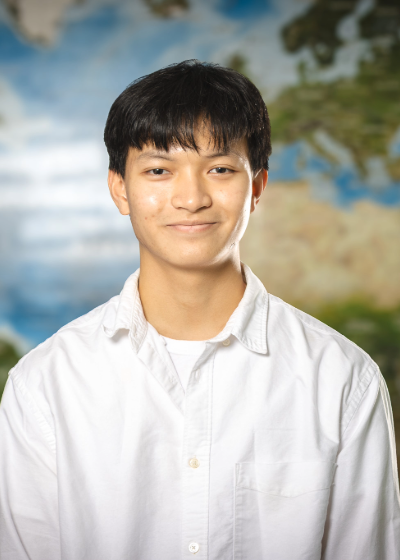
 Meet Anh Nguyen, a senior chemistry major from Vietnam who is exploring his passion for science through research, teaching and hands-on experiences at UAB.
Nguyen chose UAB because of the Department of Chemistry’s wide range of study areas, modern research equipment and the university’s strong reputation in health care and research.
What inspired you to study chemistry?
I have been interested in chemistry since middle school, and it has remained so to this day. I have always wondered how chemicals work in everyday life. Furthermore, chemistry contributes to various fields, including pharmaceuticals, environmental sciences, and other major biomedical sciences. When I was a kid, I always dreamed of helping and curing people, so I set a goal to pursue a career in the pharmaceutical industry, specifically in medicinal chemistry, organic chemistry, and biochemistry. Furthermore, since no one in my family chose science as a career, I took the chance to be different.
Are there any classes or experiences that have had a particularly strong impact on your academic development?
Specifically, organic chemistry and biochemistry have both had a great impact on me. They contribute to my analytical and critical thinking skills; they also provide me with experience engaging in lab experiments while working with chemicals, as well as an in-depth explanation of the principles behind chemical reactions and mechanisms. I love organic chemistry, and I can envision why it is important in pharmacy and medicine. For instance, natural products containing saponins act as adjuvants that may be used in vaccines. Then, biochemistry plays an essential role in evaluating how chemical compounds interact, and the results can inform precautions.
What skills have you gained through working in a research environment?
I would say patience and carefulness. Working with different techniques has shown me that patience is required, since purifying the materials takes a long time to complete a small volume. Also, if something’s wrong with the instrument, we have to discuss it and figure out a solution. Until now, I have learned that even a small mistake can take time to fix. So, if you are careful at the beginning and plan everything out, you will minimize errors. Besides this, I learned how to cooperate and communicate effectively, organize my lab space, and seek help when needed.
As a teaching assistant, how do you approach helping students who may be struggling with difficult material?
I make students feel like they are not alone and show that I am not superior. I am there to help them overcome the material and retain the content. I would ask open-ended questions to identify the situations they are in and the material they are struggling with. Then, I will break down the material into smaller steps to make it more manageable. I would also relate the concepts to everyday scenarios to make them feel more relevant to the students. Usually, I go over one to two problems to help them understand the strategies, then I let the students do some problems by themselves using their methods while explaining them to me. Overall, actively listen to their struggles, identify gaps and scaffold as needed.
What opportunities at UAB have helped you develop both academically and personally?
UAB has helped me get involved in various on-campus events to meet new people from different cultures and backgrounds, which has helped me better understand the differences among people. UAB also offers me a substantial opportunity to take a variety of courses that help build my character and broaden my knowledge in the sciences. Besides that, the university offers advanced instruments that help me to gain a deeper understanding of how we can obtain data just from a sample of material.
What are your plans after graduation?
I am currently applying to graduate schools and will pursue a PhD in chemistry. It could be organic chemistry or biochemistry. We will see where I end up. I am also considering pursuing a PharmD after I finish my PhD, but I might be too ambitious; only time will tell.