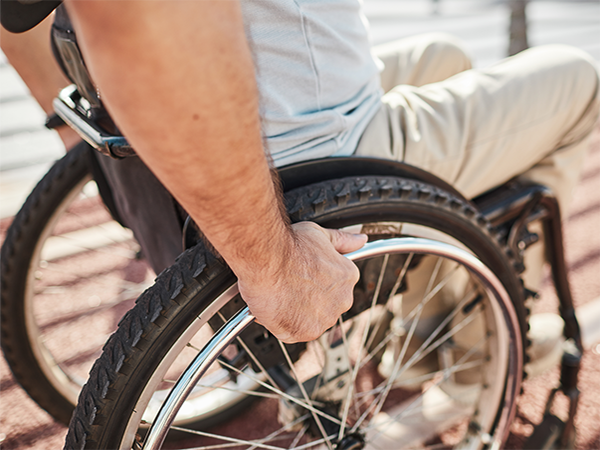
 Man pushes his wheelchair on an accessible outdoor path.Many things in life shift when you experience a spinal cord injury. How you move, care for your body, and complete daily tasks can change. One aspect of life post-injury that may be an unexpected, and literal roadblock, is the lack of accessibility in public spaces.
The Americans with Disabilities Act (ADA) is landmark legislation passed in 1990 to protect people with disabilities from discrimination in all areas of public life including employment, government services, telecommunications, and most notably, public buildings and spaces. While the law has existed for 35 years, one outing using a wheelchair or mobility device reveals many barriers that still impact the daily lives of people with disabilities.
UAB Spinal Cord Injury Model System (UAB-SCIMS) has partnered with three other Model Systems on a study led by the Northern New Jersey SCIMS at Kessler Foundation. Known as Geo SCI, the study examines how community environments affect the lives of people with SCI. At UAB, the research is led by Yuying Chen, M.D., Ph.D. and Jennifer Coker, Ph.D., MPH. The study focuses on how people with SCI work, socialize, and navigate their communities and how environment impacts quality of life and identity.
“To really understand how accessibility shapes where people go and what they’re able to do, we need to get down to the street level and observe what people experience in their everyday lives,” says Dr. Amanda Botticello, co-investigator for the Northern New Jersey SCIMS and project director/principal investigator of the Geo SCI study. “We designed this study as a citizen‑science effort so people could document the barriers they encounter and the ways they work around them in real time. The work of the ADA is ongoing, and the people most affected by policy decisions should be the ones helping to guide what needs to change, so they can live the lives they want to lead and be as independent as possible.”
Participants in the study receive a Garmin smartwatch with GPS capabilities to track routes and locations visited outside the home. Trips are tracked in three, seven-day increments, over an eight-month period. Additionally, participants complete online surveys that capture feelings about environment, stress, and physical and mental health. Finally, in-depth interviews allow researchers to gain insight into the environmental factors participants encounter and how they influence daily community participation.
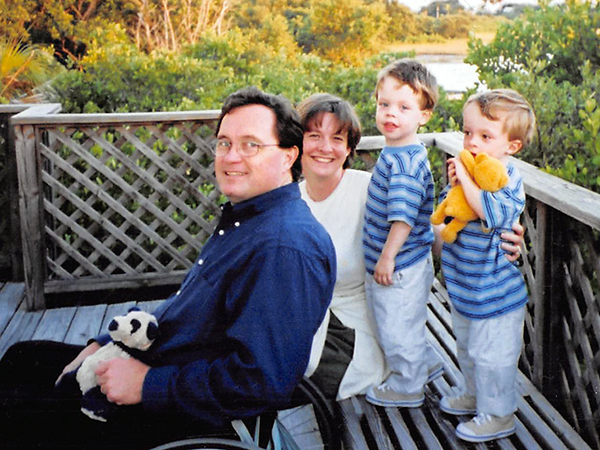 Carl Flemons, his wife Aprille, and sons Vann and Ken, vacation together in Florida.Air Force veteran Carl Flemons was eager to share his knowledge and experiences as a Geo SCI study participant. Flemons has always been an adventurous problem solver. In 1980, he was a 24-year-old working for the Army Corps of Engineers when he sustained a T8 spinal cord injury from a motorcycle accident. After completing his rehabilitation at the Memphis VA, he began to plan his next adventure – this time with accessibility in mind.
He was unable to return to his job because of its physical requirements, so he finished his degree in mathematics and took a job at the Air Force Flight Test Center at Edwards Air Force Base in California.
“Being as flat as the desert is, it was a very accessible environment,” says Flemons. “A few doors needed widening, but most buildings were only one level. I worked in a building with an elevator, so everything was fine.”
Still, Flemons recalls his first encounters patiently waiting for an accessible parking spot and being unable to access his car door because someone parked too close. At the same time, cities and businesses were learning about new ADA requirements. He did not observe rapid improvement in accessibility. In some instances, access never improved or became a compliance checkbox rather than an intentional accommodation.
“It's disappointing to see businesses doing the bare minimum, putting in a wheelchair ramp, but it's at the side or behind the building. Yes, you can get on the sidewalk, but then you've got to go all the way around the building to get into the business entrance.”
This is why the Geo SCI study is important. It measures the additional time and distance required to navigate public spaces with a disability and reveals the places and routes people with SCI simply don’t travel because of inaccessibility.
Flemons says, “If it's somewhere that’s a super hassle to get in, I simply don't patronize them. I go to places that welcome me.”
After his time in California, Flemons settled back in his hometown of Somerville, AL, built an accessible home on his family farm – including a woodworking and welding shop – where he raised his two boys and now enjoys gardening with his wife and playing with his dogs. He works for the Alabama Department of Workforce, originally assisting veterans with job placement and now as an assistant manager. Flemons also serves on the Somerville Town Council and Library Board of Directors.
He was eager to participate in the Geo SCI study, and as a technology enthusiast, marveled at the detailed maps and routes his watch produced.
“My wife and I strongly believe in education,” says Flemons.
Participating in research is his way of contributing to the SCI body of knowledge.
While the process of transforming data into action takes time, the information gathered is extremely important to policymakers and stakeholders advocating for disability access.
“So far, this project has brought together people living with spinal cord injury from all around the country and from many different backgrounds,” says Botticello. “What we’re learning will help advocates make the case for how basic infrastructure like accessible parking, public transportation, bathrooms, and ramps to name a few features can make a real difference in everyday life. It’s also about awareness. By sharing these real‑world experiences, we hope to help the public better understand what accessibility looks like on a daily basis and why it matters that everyone be included.”
Enrollment is still open for the Geo SCI study. In addition to keeping the Garmin smartwatch, participants can receive up to $600 upon completion of the study. If you are interested in participating, call 205-934-3335 or email