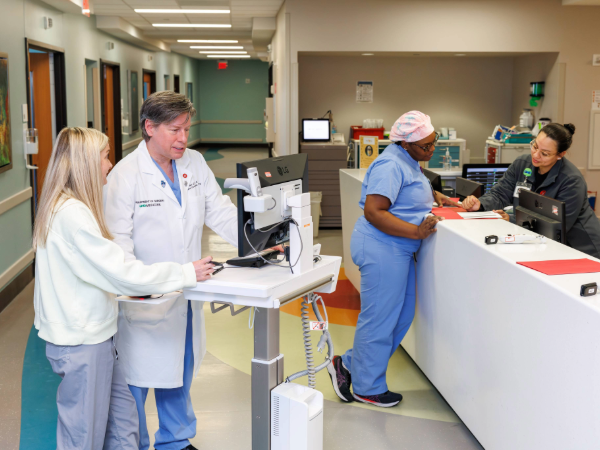
 In an effort to strengthen clinical operations leadership and develop system-level capacity for continuous improvement, Children’s of Alabama and the University of Alabama at Birmingham (UAB) Department of Pediatrics introduced the Excellence Through Partnership program, a strategic leadership model designed to align medical and nursing leadership. The program formally launched in July 2024 and now enters it’s second full year.
By pairing medical and nursing directors at both inpatient units and outpatient clinics, this dyad leadership structure created a formal framework for shared accountability, improved communication, and continuous operational improvement. The Excellence Through Partnership model aligns UAB Department of Pediatric physicians and Children’s of Alabama nursing or administrative leadership roles vertically through department vice chairs and hospital executives. By intentionally pairing physician and nursing leaders, the model reinforces shared responsibility for clinical quality, patient safety, and operational performance. The structure fosters consistent dialogue between clinical leaders while ensuring that improvement efforts remain closely tied to frontline care delivery.
The program was developed in response to recognized gaps in the prior leadership structure. Before its implementation, responsibilities and reporting relationships were less formally defined, which at times hindered communication, diluted accountability, and slowed decision-making. The new dyad model was designed to strengthen clinical governance by clarifying leadership roles, standardizing reporting pathways, and creating a reliable forum for strategic planning and problem-solving. Through regular meetings and shared improvement goals, medical and nursing directors now work in closer partnership to ensure that operational decisions remain aligned with patient-centered priorities.
Since its launch in July 2024, the Excellence Through Partnership program has demonstrated meaningful early impact. During its first year, dyad pairs established and achieved strategic improvement aims, supported by leadership development and communication training. Regularly scheduled meetings enhanced collaboration across inpatient and outpatient settings, enabling leaders to address operational challenges more effectively and proactively. Notable examples include efforts within the endocrinology clinic to reduce disparities in diabetes care led by Jessica Schmitt, M.D., and Jamelle Maxwell, RN, as well as an initiative by the heart transplant team, including Wally F. Carlo, M.D., and Meloneysa Hubbard, CRNP, to improve organ acceptance rates for patients awaiting transplantation. In addition, inpatient medical and nursing directors collaborated to ensure the successful rollout of new monitoring capabilities in the acute care units in spring 2025. This coordinated initiative has led directly to improving throughput in the hospital while maintaining patient safety.
In its second year, the program has expanded to include formal quality-improvement training in partnership with the Pediatric Office of Improvement Science. While individual clinical areas continue to pursue locally defined improvement targets, dyad pairs are increasingly working in tandem toward broader organizational goals. A major current initiative supported by the program focuses on optimizing automated scheduling systems to improve patient access to pediatric subspecialty clinics, reflecting the model’s growing emphasis on system-level improvement.
The development and implementation of Excellence Through Partnership began in 2021, when Erin Shaughnessy, M.D., executive vice chair for the UAB Department of Pediatrics, and Yung Lau, M.D., chair for the UAB Department of Pediatrics, upon assuming roles as vice chairs of Clinical Affairs, articulated a vision for a more structured and sustainable clinical leadership framework. Their proposal received strong institutional support from Children’s of Alabama CEO Tom Shufflebarger and Department of Pediatrics Chair Mitch Cohen, M.D., whose financial and administrative backing enabled the program’s launch. Ongoing leadership from Shaughnessy, in collaboration with Lau and Children’s of Alabama operational partners Tony Fargason, M.D., vice president for Clinical Affairs, Andy Loehr, DNP, RN, chief operating officer, and Delicia Mason, MNHSA, RN, NEA-BC vice president of Nursing Operations, has been instrumental in sustaining and evolving the initiative.
Together, these efforts underscore the value of intentional dyad leadership in advancing clinical excellence. By formalizing partnerships between medical and nursing leaders and aligning improvement efforts across the organization, Excellence Through Partnership has established a durable foundation for continuous improvement, enhanced accountability, and high-quality patient care.