 The University of Alabama at Birmingham has implemented an innovative fast-track surgical evaluation program designed to improve access and efficiency for patients with movement disorders such as Parkinson’s disease, essential tremor and epilepsy.
Through a coordinated, patient-centered approach, the Multidisciplinary Overnight Evaluation (MOvE) program offers a streamlined alternative to the previously fragmented, multi-visit process required for deep brain stimulation (DBS) surgical evaluation. The program was created to reduce delays, ease travel burdens and accelerate the path to treatment for patients being considered for DBS surgery.
Prior to the implementation of the MOvE program, patients often faced days or even weeks between appointments across multiple specialties and clinic locations. In many cases, this system placed a considerable care coordination burden on patients and their families. This burden was particularly challenging for patients traveling from across UAB’s expansive regional footprint.
To address these challenges, the MOvE program was initially conceptualized in 2021 by members of the Departments of Neurology and Neurosurgery, including Associate Professor Nicole Bentley, M.D., and Assistant Professor Marshall Holland, M.D., MS. 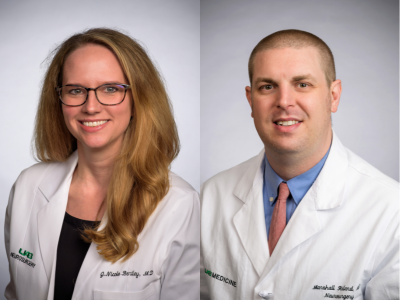 Nicole Bentley, M.D., (left) and Marshall Holland, M.D., MS (right)
The program now provides patients with a comprehensive two-day evaluation for DBS candidacy, replacing the previous prolonged approach. During their stay, patients complete all necessary assessments, including a neurosurgical consultation, neuropsychological testing and MRI brain imaging. Additional evaluations, like physical therapy assessments, speech therapy, or sleep medicine may apply in some patients with Parkinson’s disease.
“This program fundamentally reshapes how we deliver care to patients with movement disorders,” said Bentley. “By bringing together multiple specialties into a single, coordinated experience, we are reducing barriers to care while maintaining the same high standard of multidisciplinary care that UAB is known for.”
By condensing what used to take weeks into a focused two-day experience, care providers can now make timely, informed decisions and move patients more quickly toward therapies that can significantly improve their quality of life.
“We’re moving toward an ultimate goal of comprehensive care under one roof. This will greatly ease the burden for our patients and their families,” said Bentley.
According to Holland, the MOvE program “is about meeting patients and their families where they are and minimizing the stress that often comes with complex surgical evaluations.”
Patients referred to UAB for DBS evaluation typically begin with a consultation with a neurologist. Those identified as candidates can then be enrolled in the MOvE program. Internally referred movement disorder patients are able to enter directly into the two-day evaluation pathway.
Following the evaluation, UAB’s DBS committee reviews each case to determine surgical candidacy. Approved patients are then scheduled for DBS surgery. Postoperative care includes a two-week follow-up appointment and the initial device programming at three to four weeks after surgery. Long-term follow-up visits may also be conducted via telehealth, further reducing the need for travel.
Patients facing economic challenges related to their care may be eligible to receive a travel stipend to offset transportation and lodging costs through UAB’s DBS Assistance Program. Contributions to this fund are instrumental in providing coordinated care to individuals with movement disorders. Holland reflected on the motivation for this program, noting, “After caring for a patient who had to drive three hours home between day visits because they could not afford a hotel stay, it became clear that we needed to do better. I did not want to see that happen to anyone else, especially for patients already traveling long distances for care, as is common in the region we serve.”
“By having an available source of funds to assist with costs of the MOvE program, we ensure that all of our patients have equal access to care,” stated Bentley.
By consolidating multiple appointments into a single, coordinated experience, the MOvE program significantly reduces logistical burdens while shortening the timeline from evaluation to treatment, ultimately improving access to life-changing care for patients with movement disorders.
Donations to the program can be made via the DBS Assistance Program giving page. To learn more about giving opportunities, please contact UAB Neurosurgery Development at