When Michael Lyerly, M.D., MSPH, talks about what keeps him committed to neurology and medical education at UAB, he points immediately to the people he serves, including students, trainees, patients, and hospital teams across Alabama.
“It’s very meaningful to me to be giving back to and educating the next generation of clinicians who are going to be providing care in this state,” Lyerly said.
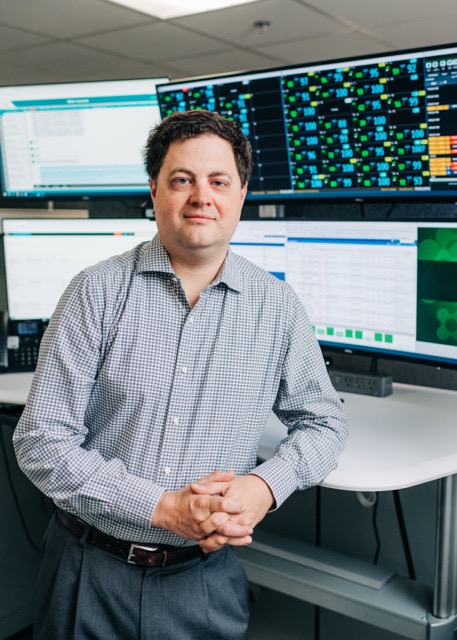 Michael Lyerly, M.D., MSPHFrom his early days as a Birmingham native returning home for medical school to now as the leader of the MS2 neurosciences course, director of the vascular neurology fellowship, and a physician lead for expanding a telestroke network that reaches hospitals statewide, Lyerly has built a career defined by innovation, hands-on teaching, and a drive to strengthen neurological care for every community in Alabama.
Path to UAB
Lyerly, whose father was a nephrologist and mother was a nurse at Carraway Hospital, grew up close to medicine. After attending Rhodes College in Memphis, he returned to UAB for medical school in 2004, stayed for neurology residency, and completed a vascular neurology fellowship from 2012 to 2013.
After training, Lyerly joined the faculty in the Division of Cerebrovascular Disease and became director of the Primary Stroke Center at the Birmingham VA Medical Center.
“The early part of my career was a little more administratively focused on running a primary stroke center and quality-focused,” he said.
In the years that followed, new opportunities shifted Lyerly’s work beyond administrative responsibilities and into teaching and curriculum development.
Educator at heart
In 2015, Lyerly joined the leadership team for the MS2 Neurosciences course, marking his entry into medical education at the UAB Heersink School of Medicine.
“It’s something that I put a lot of time and passion into, crafting what I do with the module, adapting it every single year to meet the needs of the learners and an ever-changing landscape of medical education.”
For example, he and the course leadership team redesigned the module to address “neurophobia,” an intimidation many students feel toward neurosciences.
“We wanted to reshape the module with that in mind and the students’ perspective,” he said. A major shift was prioritizing exceptional lecturers rather than relying solely on content experts.
“We wanted to focus on having really strong lecturers rather than having a content expert come and present the material in a way that may not resonate as well,” he said.
Lyerly noted how the changes made an immediate impact.
“We moved from having the lowest-rated course evaluations to the highest,” he said. “We’re now seeing that the highest-scoring area on USMLE Boards is neurosciences. It’s paying dividends that they’re doing really well on those content areas.”
And the curriculum continues to evolve, he added.
“We have to go back and look at how we need to adapt to the changing face of medical education,” he said. “We've been seeing students increasingly turning to AI for educational materials. Our challenge is to get the students to still want to commit to independent learning and mastery of content.”
Lyerly recently received the Robin Lester Award for Best Educator in Neurosciences, an honor that carries deep personal meaning.
“Robin Lester was the course director for this course when I was a medical student,” he said. “I’ve known Robin for a long time and was deeply saddened by his passing. For me, it has deep personal meaning to win this award in his honor.”
Telestroke efforts: building access, hospital by hospital
In addition to his role in medical education, Lyerly’s involvement with the VA National Telestroke Program exposed him to teaching across a wide range of clinical environments.
Beyond the classroom, Lyerly has helped expand stroke care for veterans and communities across the country while teaching hospitals how to use and implement telestroke technology. As a founding member of the VA National Telestroke Program, he helped scale the program from one site to many.
“This program expanded from starting at one hospital and has now expanded to 70 hospitals,” he said. On the go-live team, he trained staff in settings that ranged from Long Beach and Washington, D.C., to small rural VA hospitals.
He brought that experience back to Alabama to create a telemedicine system at UAB. The program began with a few affiliated hospitals and quickly grew through hands-on engagement.
Today, the UAB telestroke network includes 35 hospitals.
“But we could easily be in close to 50 hospitals,” he added.
For patients, timely access to stroke care is critical. Alabama faces high stroke mortality and many hospitals without neurologists.
“We have visited hospitals where we know that a patient would previously drive past that hospital in an ambulance for an hour to get to another hospital,” he said. “Telestroke helps bring acute neurologic expertise to the bedside, to prevent delays in care, and to be able to care for them in their community. If they can stay in their community, that’s huge.”
What sets UAB’s model apart is personal engagement.
“We’re not just putting a cart in an emergency department with a phone number and saying call us,” he said. “We’re going out and interacting with these providers, physicians, nurses, administrators, and frontline staff in the lab and in pharmacy, to enhance stroke care in our community.”
Training future neurologists and goals ahead
Lyerly remains focused on strengthening Alabama’s neurologist workforce.
“Nationwide, only about 2.5 percent of U.S. medical graduates choose to go into neurology,” Lyerly said. “We’re doing at least twice that here at the UAB Heersink School of Medicine. It’s very meaningful to me to be giving back to and educating the next generation of clinicians who are going to be providing care in this state.”
On the telestroke side, expansion remains a clear goal, but infrastructure remains a barrier.
“We’re up against some financial barriers,” he said. “I think we are hopeful that rural transformation dollars may be able to let us expand even further into some rural areas of the state that have no services.”
For Lyerly, the path forward is clear.
“My true passion is our telemedicine network and enhancing the pipeline for future neurologists in Alabama,” he said. “There’s ongoing opportunity for growth.”