 Cristina Magi-Galluzzi, M.D., Ph.D., did not initially set out to become Chair of the UAB Department of Pathology. She set out to be the best pathologist she could be. What happened next is a lesson in what leadership actually looks like when it grows from the ground up.
"My path was not a straight line or the result of a single opportunity," she said. "It was built through continuous learning, collaboration, resilience, and a genuine commitment to supporting people and advancing the mission of academic pathology."
That commitment has carried her from early-career clinician to one of academic medicine's most respected department chairs, and through the UAB Medicine Leadership Development Office’s (LDO) Institute for Leadership, she found the language and the strategy to match the instincts she had already developed.
AT A GLANCE: Cristina Magi-Galluzzi, M.D., Ph.D.
- Named Chair of Pathology at UAB
- M.D., University of Ancona
- Ph.D., University of Verona, Italy
- Residencies at Rush and Brigham & Women’s; Fellowship at Johns Hopkins
- Specialty: Genitourinary pathology — prostate, bladder, kidney, adrenal
- 270+ peer-reviewed papers
- Editor of four GU pathology books
- Robert and Ruth Anderson Endowed Chair
A transformational experience
When Magi-Galluzzi joined LDO's Institute for Leadership cohort, she was already fully running a department. What the program gave her was something harder to find in a job alone: it gave her perspective.
"The opportunity to learn from leaders with very different backgrounds, leadership styles, and experiences helped broaden my perspective," she said. "The cohort environment created a space for honest conversations about leadership, both the rewarding aspects and the difficult ones."
One of her biggest takeaways was how much leaders across specialties and institutions share in common. Communication challenges, faculty engagement, resource constraints, competing priorities. The problems look different on the surface, but the skills required to solve them are often the same.
“Regardless of specialty or institution, people face similar issues. What differs is how you meet them.”
From theory to practice
The program's emphasis on strategic communication landed differently for Magi-Galluzzi than she expected. It was not just about speaking clearly. It was about recognizing that how decisions are communicated is often just as important as the decisions themselves.
"Transparency, consistency, and listening build trust, especially during periods of change," she said. That insight has shaped how she leads her department today, where regular communication and consistent faculty engagement are not just nice-to-haves. They are how culture gets built.
She also credits the program with sharpening her approach to change management. "Implementing operational or cultural changes requires patience, clear rationale, repeated communication, and engagement of stakeholders," she said. For a department as complex as pathology, where clinical operations, research, and education intersect daily, that patience is not passive. It is a strategy.
Leadership as a journey
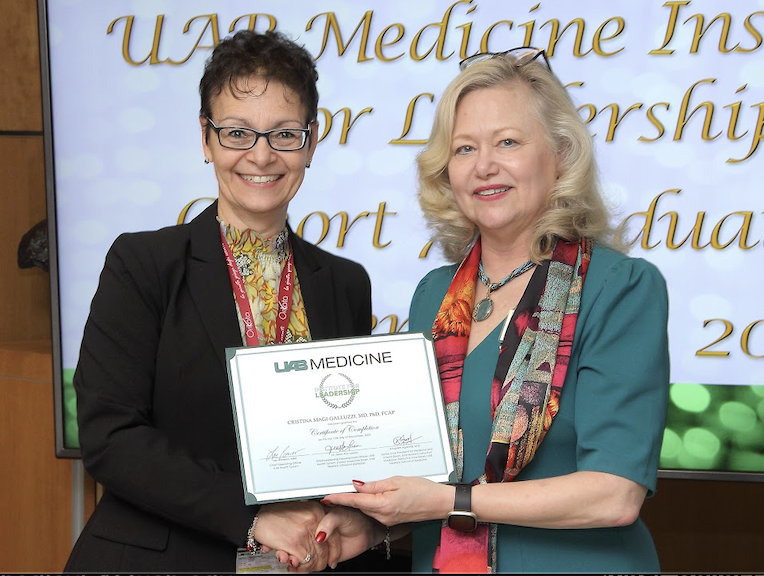 Long before she enrolled in any leadership program, Magi-Galluzzi was paying attention. Early in her career, she found herself curious not just about pathology, but about how departments work, how teams are built, how systems fail, and how leaders can shape environments where people actually thrive.
"As I became more involved in departmental service, I had opportunities to lead programs, mentor junior colleagues, and participate in operational and strategic initiatives," she said. "Those experiences helped me realize that leadership in academic pathology is about creating environments where others can succeed."
Mentorship was central to that evolution. She is quick to credit the leaders who pushed her toward opportunities that, at first, felt outside her comfort zone.
"I benefited greatly from leaders and colleagues who invested time in me, provided guidance, and encouraged me to pursue opportunities that initially felt outside my comfort zone."
“One does not need to have all the answers to be ready for a leadership role.”
An investment in people
Now, as Chair, Magi-Galluzzi thinks a lot about what it means to pay that investment forward. Her advice to anyone entering a leadership program is direct: be clear about what you want to gain, listen carefully, and build relationships across disciplines and backgrounds.
"Find mentors, but also peers who will challenge and support you honestly," she said.
She is also candid about what she wishes she had understood sooner that leadership is not about having the answers. It is about asking the right questions, staying flexible, and being willing to keep learning, even from the hard parts.
"The program reinforced that leadership is a continuous learning process," she said. "I continue to reflect on feedback, adapt my approach, and learn from both successes and setbacks as I grow in the role of Chair."
That willingness to stay in the process, not to arrive at any conclusion, but to always keep growing, is the clearest sign of the leader Magi-Galluzzi has become.
About the Program
UAB Medicine Institute for Leadership (Senior/Mid-Level Leaders)
The goal of the UAB Medicine Institute for Leadership is to enhance existing personal, leadership, and management competencies while leveraging current leadership strategies and trends. Guest speakers from executive-level leadership positions at UAB, including former Institute for Leadership graduates, complete the dynamic curriculum by demonstrating skills-to-practice experiences. This program is offered in the fall and spring.
Learn about more programs →