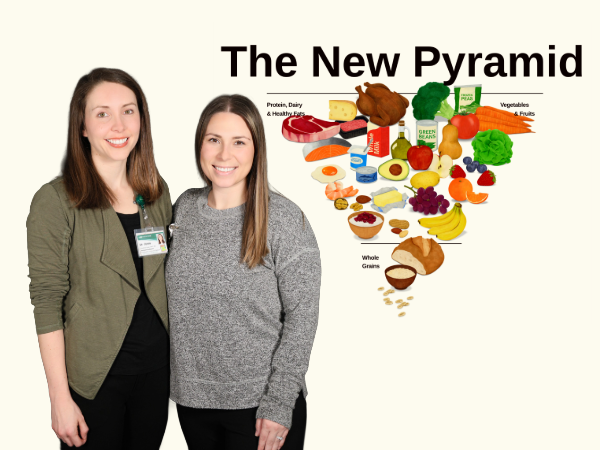
 Caroline Cohen, Ph.D., LD, RD, and Tori Faught, MS, RDN, LD, explain new food pyramid guidelines. UAB Family and Community Medicine dietitians are fielding questions about the new food pyramid. Released in the latest set of nutrition guidelines, the new take on a 1992 classic has some Alabamians scratching their heads.
The U.S. government publishes updated dietary guidance every five years—"Dietary Guidelines for Americans.” Often accompanied by a visual representation, like the 1992 food pyramid or the 2011 plate, the USDA and DHH raised eyebrows when they released an inverted pyramid along with their 2025-2030 recommendations.
Registered Dietitian and Assistant Professor Caroline Cohen, Ph.D., LD, RD, believes the New Pyramid is a way to draw attention to its differences with prior iterations.
“I do think it’s an intentional, kind of like, we’re turning the food pyramid upside down,” said Cohen. “We’re talking about 'real food' this time. This is a fresh, new take on nutrition.”
According to the official website for the new guidelines, more than ever, the U.S. guidance “calls on Americans to avoid highly processed foods.” It describes real food as whole, nutrient-dense and “recognizable as food” with “few ingredients,” no added sugars, “artificial flavors or preservatives.”
“I think there's a lot of great things about it, like eating whole foods and trying to minimize added sugars, which I already promote,” explained Registered Dietitian Tori Faught, MS, RDN, LD. “Whole grains are still needed but, naturally, get them from actual whole foods sources and not through processed foods… Cereal is fortified with nutrients, but you're better off eating oats, brown rice, or quinoa to get your whole grains.”
This is not to say all processed foods are unhealthy.
“Peanut butter is technically processed because it has been ground up into something different,” said Cohen. “What they’re talking about is the highly refined carbohydrates—what makes up most of our grocery stores these days, which are cereals, crackers, chips, things like that.”
While authors clearly aim to highlight their emphasis on “real food,” dietitians are eager to clarify any confusion surrounding other aspects of the guidelines, like new recommendations for protein and fat.
Protein
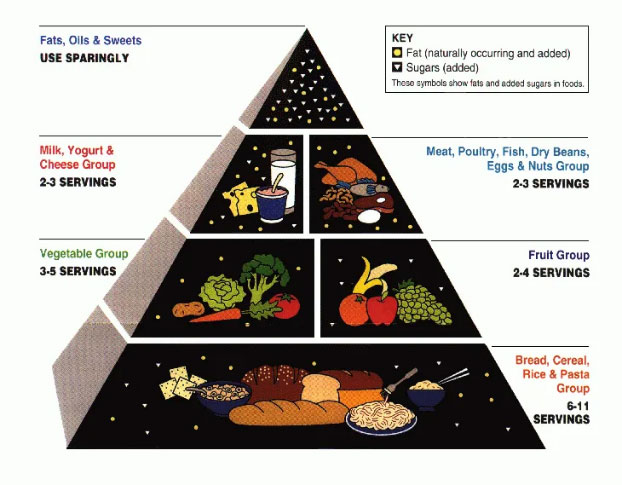 Updates to the 1992 food pyramid have left many people with questions.Previously 0.8g/kg, dietitians once advised folks to refer to the size and thickness of their palm as a guide for protein portions. Now, guidelines call for nearly double that amount—between 1.2 g/kg and 1.6 g/kg of protein.
“It's a big leap. And, if you're basing it on body weight and most of America has obesity, that means that we're recommending some serious amounts of protein,” said Cohen. “The other thing is, ‘what's the cost?’ That's been, maybe, minimized.”
Faught agrees—it’s a big jump—but it is on par with what she currently recommends.
“I always go off 1.2 g/kg with every day, average people. I often use 1.6 g/kg for my active individuals. For athletes, it’s sometimes even higher,” Faught explained. “The RDA is .8g/kg, which is pretty low.”
She describes the RDA or Recommended Dietary Allowance as the “bare minimum.” The NIH defines it as the average daily level of intake necessary to meet the nutrient requirements of nearly all healthy individuals.
Fat
“It's more permissive of saturated fat,” Cohen pointed out.
In the New Pyramid, red meat, full-fat dairy and cheese are at the top. These are all significant sources of saturated fat.
“But the saturated fat guideline they're providing is the same, which is to limit it to 10% of your total calories. I think that's a little bit confusing for the average American to understand,” explained Cohen.
Faught says many Americans should monitor their intake of saturated fat since it raises cholesterol levels.
“The leading cause of death in the U.S. is heart disease, which is directly linked to cholesterol,” Faught said.
She says it varies from person to person, but explains many active, healthy people can eat more red meat and cook with butter. Yet, that is not most Americans. A 2021 study published in the American College of Sports Medicine surveyed a sample of U.S. adults who reported a mean of 9.5 sedentary hours a day.
Conclusion
“My main concern is people will view these new dietary guidelines, the New Pyramid, and see, ‘Oh, so now I can have red meat. I can have full fat dairy,’” said Cohen. “People tend to latch onto things they like about the dietary guidelines, and maybe they minimize the stuff they don't like.”
Cohen says these guidelines can be helpful in laying out a baseline for active Americans. However, the advice of one’s doctor supersedes any federal dietary guidance, especially for those at risk of chronic illnesses, like heart disease or diabetes. Cohen says there are consequences to picking and choosing what guidance to take or misinterpreting the information.
“We could end up seeing people eating more red meat, but they're not necessarily limiting refined grains or added sugars. And that is kind of a catastrophic metabolic combination when it comes to cardiometabolic disease,” Cohen explained.
She says coming up with dietary guidelines for millions of people in a concise and understandable way is an incredibly challenging task.
“Nutrition is nuanced, and it's a young science,” said Cohen. “Whenever you ask a nutrition question of a dietitian, including me, most often my answer is going to be, ‘well, it depends.’”
If you have further questions about your diet or how the new guidelines might apply to you, check your insurance benefits to see if dietitian services are covered. Often, individuals are allowed a certain number of visits per year with little to no copay. Call the UAB Family Medicine Clinic at 205-934-9700 to make an appointment.