Behind every successful study is a network of people willing to participate, share their experiences, and contribute to knowledge that can improve health outcomes. At the Comprehensive Healthy Living Research Center, that critical connection between investigators and participants is supported by the Participant Access to Research Core (PARC).
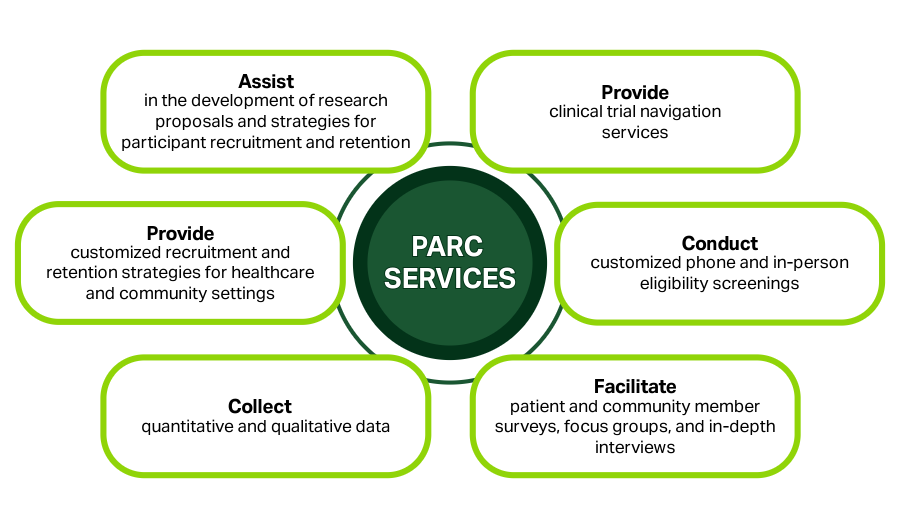
PARC, previously known as the Recruitment and Retention Shared Facility (RRSF), assists investigators in reaching their study goals by providing comprehensive support for participant recruitment, retention, and data collection across community-engaged and population health studies, as well as clinical trials. Built on decades of experience and deep community relationships, PARC plays a central role in ensuring research is both rigorous and grounded in real-world perspectives.
A comprehensive approach to participant engagement
As faculty co-leader and Director of the Comprehensive Healthy Living Research Center, Mona Fouad, M.D.,
explained, PARC brings together the expertise and infrastructure needed to support a wide range of studies without requiring individual teams to build this infrastructure.
“PARC is a one-stop shop to assist investigators with enrolling and retaining participants for population- and community-based studies, and clinical trials,” she said. “Our staff has developed the infrastructure and expertise to work in different environments, such as hospitals, clinics, and community settings, which helps investigators reach their study goals without having to recreate those systems for every project.”
Guided by co-directors Julie Schach and Cynthia (CY) Johnson, the work conducted by PARC reflects a long-standing commitment to thoughtful, respectful engagement.
Experience, trust, and relationships
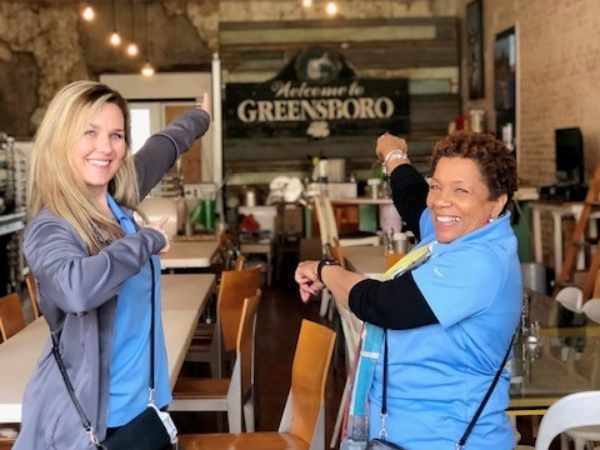 PARC Co-directors Julie Schach (left) and CY Johnson (right)One of PARC’s defining strengths is its experienced team and the trust they have built over years of working closely with health care providers, community members, and research participants.
“The most meaningful part of my work with PARC is building relationships with people in the community and helping them feel valued as partners in research,” Schach said, speaking to her personal commitment to the work.
Offering a coordinated approach to engagement is a key differentiator for how PARC builds trust with patients and community members.
“Over the years, PARC has established trusting relationships in the community through health screening events and by educating community members about research and its importance in advancing health care,” Fouad said.
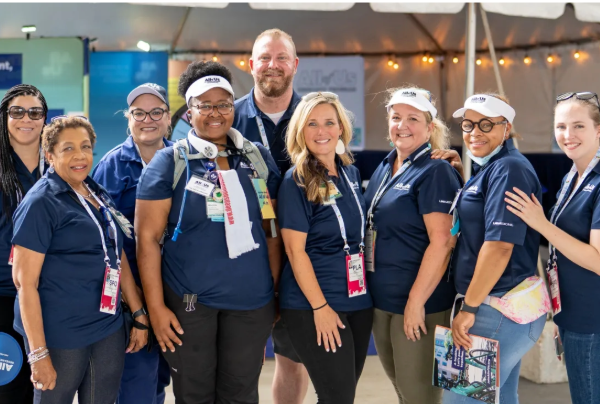 She added that this coordination allows communities to experience UAB research as “one voice rather than multiple investigators competing for participants,” while also creating space for community feedback and concerns.
That continuity and familiarity allows PARC staff to engage participants across a wide range of studies, from cancer survivorship, genetics, and Alzheimer’s research to wellness initiatives and opioid-related projects. According to PARC staff, participants are often motivated by a desire to help others, even when sharing deeply personal experiences.
Supporting impactful research
PARC currently supports multiple projects across UAB, partnering with investigators to ensure studies are accessible, responsive, and informed by participant perspectives. These efforts help researchers better understand patient experiences, identify gaps in care, and develop interventions that reflect the needs of the populations they serve.
Alabama Genomic Health Initiative (AGHI)
One project supported by the core is the Alabama Genomic Health Initiative (AGHI), a statewide effort launched in 2017 to expand access to genomic medicine and improve health outcomes through population-level screening and whole genome sequencing. Led by Nita Limdi, Pharm.D., Ph.D., AGHI has enrolled more than 10,000 participants from all 67 Alabama counties and integrates genomic insights into clinical care across primary and specialty care settings.
As AGHI expanded, PARC played a central role in supporting large-scale recruitment and engagement.
“PARC offers a very nimble, flexible recruitment, retention, and engagement service,” Limdi said. “When you’re trying to recruit large numbers of patients quickly, especially for genomic studies where consent and data sharing are complex, that depth of experience is absolutely crucial. The PARC team has been a great partner to really engage with participants.”
Limdi also emphasized that PARC’s expertise allows investigators to focus on the scientific aims of their studies rather than building recruitment infrastructure from scratch.
Primary Care HEART NET
PARC’s expertise also supports the Primary Care HEART NET network, a multisite initiative designed to strengthen primary care research infrastructure across the Deep South. Through HEART NET, programs such as iReach Rural, a digital behavioral weight management study, and Hear Here Alabama, a community-focused hearing-health initiative, engage participants in both urban and rural settings, helping clinics implement research processes that integrate local feedback and reach diverse populations.
Irfan Asif, M.D., chair of the Department of Family and Community Medicine, associate dean for Primary Care and Rural Health, co-director of the UAB Comprehensive Healthy Living Research Center, and Multiple Principal Investigator for HEART NET, spoke to how PARC maintains trust with communities, helping the overall mission of HEART NET and its studies.
"The PARC team has been an exceptional partner in supporting both the Hear Here Alabama study and iReach, a digital weight-loss program," he said. "Their deep understanding of clinic workflows and local communities led to outreach strategies that truly worked. Thanks to their efforts, UAB Selma contributed meaningfully to HEART NET enrollment, with 38% of participants identifying as Black/African American—the highest proportion among participating clinics."
He also highlighted PARC’s consistency and on-the-ground engagement.
"Julie, CY, Bridget, and Alia from the PARC team played a pivotal role in reaching underserved communities for both the iReach program and hearing-health initiatives. Their responsiveness and on-the-ground engagement not only helped diversify enrollment, but also connected dozens of individuals in Selma and Demopolis to free screenings and essential support for health.”
A people-centered approach to research participation
Behind PARC’s infrastructure and study support is a people-centered approach that prioritizes respect, clarity, and care in every interaction with participants. For investigators, this approach helps ensure that research protocols are carried out thoughtfully and consistently. For participants, it creates an environment where questions are welcomed and contributions are valued.
For Julie Schach and Cynthia Johnson, that responsibility is something they approach with intention.
“Our work matters because it brings research to people in a way that is respectful and accessible,” Schach said. “We put care into listening, earning trust, and showing up for participants and communities beyond a single study.”
“It’s been the job of a lifetime for me,” Johnson said. “A lot of these interactions are some of the help that community members would ordinarily not get. They just want to know that someone else cares.”