Meet the Minds of CDIB spotlights the diverse faculty who power the department’s groundbreaking research. Through candid interviews, it gives readers a closer look at the career paths, passions, and real-world impacts of UAB researchers shaping the future of medicine.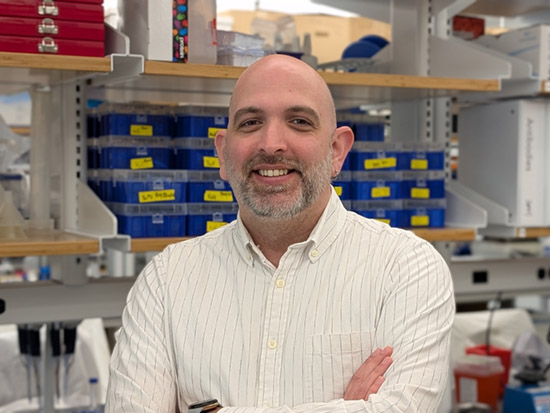
Robby Van Sciver, Ph.D., is an assistant professor in the Department of Cell, Developmental, and Integrative Biology, whose research focuses on studying Polycystic Kidney Disease (PKD) and cilia biology using mouse models.
Van Sciver’s academic career began at the University of Virgina where he majored in chemical engineering. While never feeling connected to lecture-based classroom teaching, Van Sciver’s perspective shifted when he began volunteering as an undergraduate researcher.
By applying concepts from fields like microfluid flow and synthetic chemistry to real-world discovery, Van Sciver discovered a connection in his study that led him to transition to a biopharmaceutical startup. However, after the 2008 economic crash, he pivoted his plan to the lab of Robin A. Felder, Ph.D., at the University of Virginia. This introduced him to a new field of science—biology.
“I was introduced to cell biology and began studying salt sensitive renal hypertension,” Van Sciver said. “It was challenging at first since my major did not require any biology coursework and my last formal education in biology was tenth grade, but I leaned into the challenge and enjoyed the process of learning through experience.”
“I knew I wanted to start asking my own questions and leading my own group, so I decided to pursue a Ph.D.”
Van Sciver would later attend Eastern Virginia Medical School studying cancer and developmental biology while also building the foundation for his current lab.
Autosomal Dominant Polycystic Kidney Disease (ADPKD) is one of the most common inherited monogenic diseases, yet it remains relatively unknown to the public. Van Sciver experienced this firsthand when he received a fellowship to study PKD.
“After sharing the news on social media, I was stunned to learn that three of my own high school classmates had a family history or personal diagnosis of the disease,” Van Sciver said. “In the Van Sciver lab, we are working to unmask what drives this disease.”
By using genetic models to study how specific ciliary proteins act as 'switches' for cyst growth, Van Sciver hopes to identify new therapeutic targets that can stop disease progression and offer better options for the millions of families worldwide affected by PKD.
While there are many preclinical and clinical trials currently underway for PKD, very few target the actual source of the disease known as primary cilium.
“My research aims to identify the upstream and downstream ciliary mechanisms that drive cystogenesis,” he said. “A particularly thrilling aspect of this work is the evidence from preclinical mouse models suggesting that PKD cysts may actually be reversible.”
A major goal of the Van Sciver lab is to determine if this reversibility is unique to PKD or if it applies to other forms of renal cystic disease.
“By shifting the focus to these fundamental ciliary pathways, we hope to move toward therapies that don't just slow the disease but potentially reverse its course for a wide range of patients.”
Van Sciver joined UAB primarily because of its reputation as a world-class cilia and PKD hub.
“The density of expertise in cilia biology and nephrology here is virtually unparalleled, providing a rich environment for my research to thrive,” Van Sciver said.
During his interview at UAB, Van Sciver was touched by the unique culture and by how many faculty members had a prior connection to UAB and had intentionally chosen to return. He stated that this was a clear testament to the quality of the community.
“That eagerness to collaborate across disciplines, rather than work in silos, made it clear that UAB was the ideal place to build a lab and push the boundaries of PKD research,” he said.
Embracing change is a testament of Van Sciver’s career. Though his journey took him through many challenges, Van Sciver believes that resilience is built thorough moments of pivot. He encourages students to get comfortable in the unknown as a closer step to discovery.
“Scientific careers rarely move in a straight line,” Van Sciver said. “But a relentless curiosity and the courage to ask questions are what truly drive innovation forward.”
Follow along with the Meet the Minds of CDIB series to discover more about the faculty advancing science at UAB.