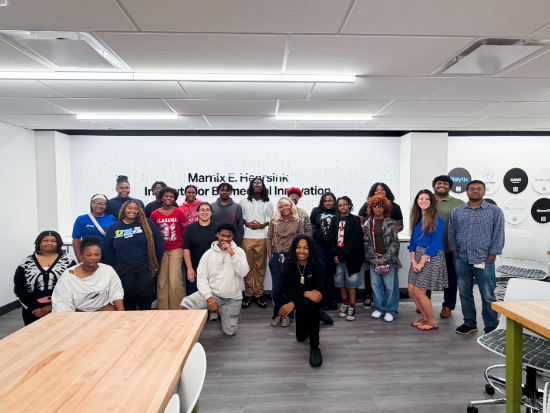
 Twenty-two high school students from Upward Bound Math and Science at UAB spent an evening getting an inside look at how artificial intelligence works before putting it to the test themselves. The Marnix E. Heersink Institute for Biomedical Innovation (MHIBI) and the Upward Bound Academy hosted students in the Innovation Clinic for an interactive educational workshop around AI.
The Upward Bound Academy is a year-round, pre-college TRIO program funded by the U.S. Department of Education. It serves high schools in Birmingham City and the greater Birmingham area, supporting students who would be the first in their families to attend college or who come from economically disadvantaged backgrounds. Students in the academy receive tutoring, mentoring, counseling, career exploration, and help with scholarship and financial aid applications.
The academy's Upward Bound Math and Science Program is for students with strengths in those subjects who want to pursue a STEM career, which made an evening on AI and medicine a natural fit.
The workshop, titled "Intro to AI: How it learns, where it goes wrong, and how it's changing medicine," was led by Abhiraj Pudhota, innovation deployment manager, with Sandeep Bodduluri, Ph.D., deputy director and director of academic programming, and Kelly Powell, program director, supporting this initiative from the MIHIBI team.
The students arrived already well acquainted with AI. In a survey before the visit, every participant who responded said they had used it for schoolwork, and about half said they use AI tools often or every day. They were less sure, however, about what comes next. When asked about AI's role in their future, 41% said they were worried, 11% said they were excited, and the rest were neutral.
That mix of everyday use and unease shaped the workshop. The goal was to help students understand a tool they already use, so by the end of the night, they could explain how AI learns, spot its mistakes, write better prompts, and see how AI is already used in medicine.
Games kept the ideas concrete. To see how AI learns from training data, students played the part of an AI model and had to derive similarities to classify objects into two categories. Pudhota noted that he purposely chose a classification system other than what would be most readily apparent to the eye to illustrate the errors a model can make but was proud that the students worked together to figure out the right answer.
To understand that a large language model (LLM) is a predictive model that makes suggestions based on the likelihood of the next word, they finished familiar phrases such as “peanut butter and...” They then tried to trip up a chatbot with trick questions, including who the first person was to walk on Mars, and saw why a confident answer is not always a correct one.
Next came CRAFT, a prompting method adapted from Bodduluri's teaching that turns vague requests into specific ones. The letters stand for Context, Role, Ask, Format, and Tweaks.
The final topic was medicine, where AI already helps read scans, flag patients whose conditions may be worsening, draft visit notes, and speed up drug discovery. In each case, a person still oversees the AI, an approach known as “human in the loop.” One student echoed that idea in the survey, writing, "AI is something that is meant to assist, not take over."
Along the way, students saw where they could fit into the field, with careers ranging from medicine and biomedical engineering to data science, research, ethics, and app development.
To close out the evening, attendees participated in a 30-minute demonstration of AI tools built at MHIBI. Students then had hands-on time with the technology, testing a number of the tools themselves and saw firsthand how they work.
For Ashley Pettway, assistant director of the Upward Bound Academy, the evening made an impression that will last.
“I truly believe our students left the session with valuable information, new perspectives, and a greater appreciation for the impact AI can have across various fields," said Pettway.
Students arrived as everyday users of AI with more worry than excitement about where it is headed. They left knowing how it learns, where it stumbles, and how to ask it better questions, along with a clearer picture of the careers open to them if they want a hand in shaping it.