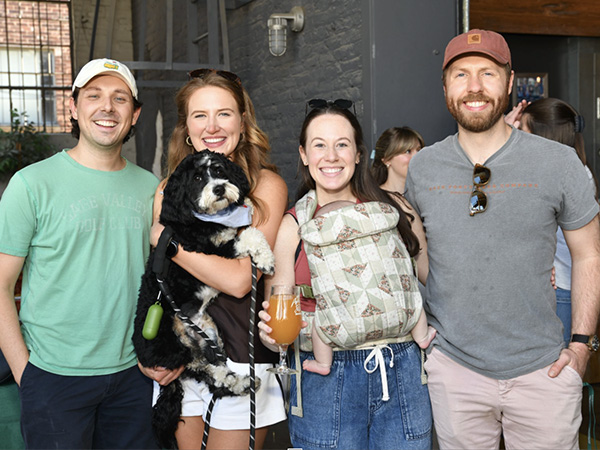
By: The 2025–2026 CMRs
It is hard to believe the academic year is coming to an end. It feels like it just started, and only now, just as we are finally settling into our roles and finding some semblance of a rhythm, we are preparing to hand the reins off to the next group of chiefs and step into an entirely new set of roles come July 1.
There’s something both exciting and disorienting about that realization. Residency has a way of teaching you just enough to feel comfortable right before asking you to take the next step forward. And in many ways, that’s exactly where we find ourselves now: grateful for the growth, aware of how much we’ve learned, and still humbled by how much lies ahead.
Serving as chief residents has given us a vantage point we didn’t fully anticipate. We’ve had the privilege of seeing the program not just as participants, but as stewards, tasked with balancing schedules, advocating for residents and trying to make a demanding (and sometimes imperfect) system just a little bit better. This year, that stewardship came with its own unique challenges.
We navigated budget constraints that forced difficult decisions, challenging us to think critically and problem-solve in ways we had not previously experienced. What we are most proud of, however, is what did not change. These constraints pushed us to be more creative, and our program continued to show up for one another. Traditions endured, not because they were easy to sustain, but because they mattered. From small gestures like candy rounds to larger gatherings such as the residency crawfish boil, PGY-3 legacy dinner, PGY-2 retreat and our upcoming spring banquet, we remained committed to fostering connection and community. Even amid challenges, these shared moments served as a reminder that the culture of a residency is shaped not only by the work we do on the wards, but by the people we share it with.
At the same time, we found ourselves leading and training in a rapidly evolving landscape. The growing presence of artificial intelligence in medicine has introduced both excitement and uncertainty. Over the past year, our program has taken steps to thoughtfully introduce residents to select AI tools to support education and streamline tasks like note writing, with the goal of spending less time typing in the corner of a dim workroom and more time at the bedside, building connections and providing meaningful clinical care, which are the very reasons many of us chose this profession.
What cannot be lost in this rapidly evolving landscape is that the seemingly simple act of sitting down to truly listen to our patients remains one of the most important things we do as physicians. Sometimes, all a patient wants is to feel heard. Sitting at the bedside, listening to concerns and offering reassurance can matter just as much, if not more, than any lab, imaging study or carefully crafted plan. It echoes the words of Sir William Osler: “The good physician treats the disease; the great physician treats the patient who has the disease.” Residency trains us relentlessly in the science and the art of medicine, but it is the third root, the deeper calling to connect with and advocate for our patients, that truly defines our growth as physicians. It is this same principle that makes training at UAB so special, where we are challenged not only to be clinically excellent, but also to be equally thoughtful in how we care for and relate to our patients as people.
We’ve watched this program grow, not just in size or reputation, but in the way people consistently show up for one another. Whether it is supporting a co-resident after a long and difficult week or stepping in without hesitation when someone is navigating an unexpected personal hardship, our residents have demonstrated a remarkable willingness to be there for each other without expectation or recognition. This spirit reflects our shared motto, excellence without ego. There is something truly special about a place where excellence is the standard, but kindness is never sacrificed in its pursuit.
To the residents: thank you for your trust, your resilience and your patience with us. We are not perfect and have certainly made our share of mistakes along the way. Most of all, thank you for your willingness to keep showing up, even on the hardest days, nights, weekends and post-call conferences. Good luck in your next steps.
To the faculty and staff: thank you for your mentorship, guidance and unwavering commitment to training not just competent physicians, but thoughtful ones.
And to the incoming chiefs: you are stepping into a role that will challenge you in new and unexpected ways, but also reward you in ways you may not fully appreciate until you look back on the year. It is a year of tremendous growth. Remember that you are not doing it alone, and you have each other to lean on.
As we prepare to move on to the next phase, we carry with us the lessons, the friendships and the quiet confidence that comes from having been shaped by this very special place.
Sydney Blankenship will be moving to Chattanooga, Tennessee, to work as a hospitalist at Erlanger Baroness Hospital alongside her fiancé, Adam, as he completes his OB/GYN residency. After eight years at UAB, she closes this chapter with lasting gratitude for the mentorship, friendships and experiences along the way.
Thomas Ruli will be moving with his wife, Elizabeth, to Phoenix, Arizona, to begin his cardiology fellowship at the University of Arizona College of Medicine – Phoenix. While he is excited about the next chapter and being closer to family, he will miss his co-chiefs and close-knit UAB family.
Griffin Selch will be staying for a Pulmonary and Critical Care Medicine fellowship at UAB. He is excited to continue training alongside mentors, colleagues and friends who make Birmingham a special place. He still thinks this is the coolest job in the world.
Katie Vickers will be staying at UAB for a Pulmonary and Critical Care Medicine fellowship. She is grateful to be continuing her training in a place that has meant so much to her growth as a physician and as a person.