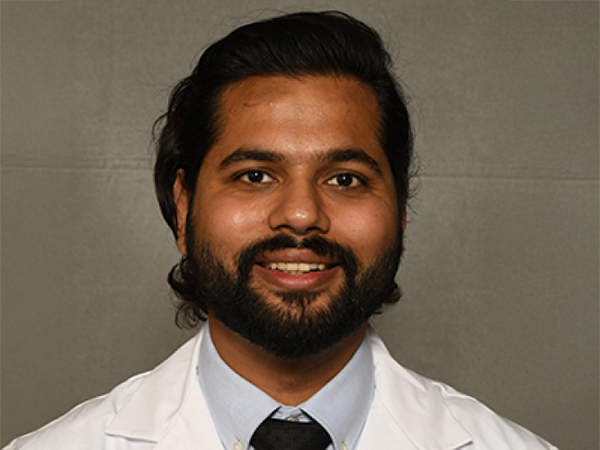
By: Shiv Ishpujani, PGY-2
I’ve always been the kind of person who tries to keep spirits high in the team workroom. When days in the MICU stretch too long and the hours blur together—when the air feels heavy and the pages seem endless—I’m the one cracking a joke or queuing up a playlist. It isn’t about the music—it’s about rhythm, keeping the pulse of the team alive. Because in residency, as they say, the show must go on.
That optimism wasn’t accidental; it was forged by a life that never made things easy. Hardship trained me to look for light when there was none. When I couldn’t afford medical school, merit was the only door. When I didn’t make the cut for a scholarship the first time, I studied harder and tried again. When I fell sick during finals, I unhooked the IVs, borrowed a wheelchair, and showed up for my exam. When the pandemic closed every gate to my dream of training abroad, my 10th visa application was finally granted.
My father used to tell me, “Losing is fine, accepting a loss is not.” Somewhere along the way, those words became my default setting. For years, resilience was my answer to everything: push harder, endure longer, and never accept defeat.
But that is not always the answer.
She was twenty-five, a student two years younger than me. “Kind, curious, and full of life”, her friends said.
Records from the outside hospital told her story. It was brief and straightforward: fever and fatigue two weeks earlier, attributed to a simple viral illness, perhaps the flu. She was seen and discharged to recover at home. She walked back to the outside ED days later—same fever, same fatigue—then suddenly collapsed. She was transferred to us overnight, now intubated and sedated.
Her labs returned when I took over the next morning: a white blood cell count of 450,000. Acute myeloid leukemia in blast crisis. Before we could round, the head CT revealed a catastrophic intracranial hemorrhage with brainstem herniation secondary to hyperviscosity syndrome.
I ran to her room.
Turned down the sedation.
Called her name.
Pressed my knuckles against her chest, waiting for any flicker.
Nothing.
I tried again—louder this time—because that’s what I do: I try again.
I suctioned her tube, lifted her eyelids, searched for any hint of life. Her pupils were unreactive, wide—larger than the void forming in my chest.
I waited. And then, I tried one more time.
But she wouldn’t wake up.
My resilience was useless. She was gone before I had the chance to fight for her.
Her family was in India, much like mine, unable to travel. I had to tell them that their daughter had died halfway across the world. Her mother fainted from the shock. I stood there utterly silent.
There was no music in the workroom that day—only the sound of pagers beeping, filling a silence none of us knew how to break.
We’ve all lost patients before. We’ve seen death and mourned quietly. I always comforted myself with the thought: at least I tried. That phrase was my refuge—proof that efforts mattered, even when outcomes weren’t what we hoped for.
But this time, I never got the chance. There was no code to run, no medication to push, no space for resilience to prove itself useful. I stood at her bedside with my hands empty and my willpower meaningless, and that hurt more than any failure ever could. I realized all of life's moments aren’t always about holding on until your knuckles bleed, not every battle is won by fighting harder; some are simply meant to be felt.
I still play music in the morning in the workroom.The show does go on.But between those songs, I remember her.And even now, I sometimes catch myself wondering—Did I try hard enough to wake her up?