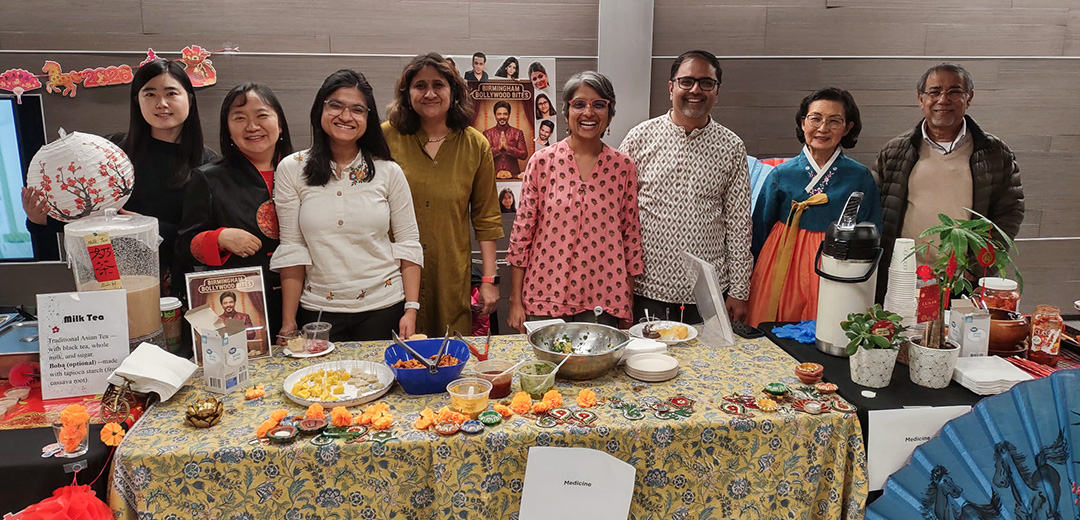
 DOM Cultural Connections Food Fair participants celebrate a successful evening of food, tradition, and community.Our love for food is rarely just about eating. Food connects us to stories, memories, tradition and community.
On Thursday, February 5, the Heersink School of Medicine hosted its annual Cultural Connections Food Fair in the UAB Hospital’s North Pavilion, 2nd Floor Atrium.
The aroma of decadent dishes from around the world filled the room as participants gathered to celebrate a wealth of global cultures.
Three teams from the DOM joined in the fun, sharing traditional Asian, Indian, and Korean foods.
We asked each team what made their dishes special. Though we couldn’t capture every story, one volunteer from each team shared a meaningful moment behind a dish and what it meant to them.
Connecting Food with Culture: Kim’s Story
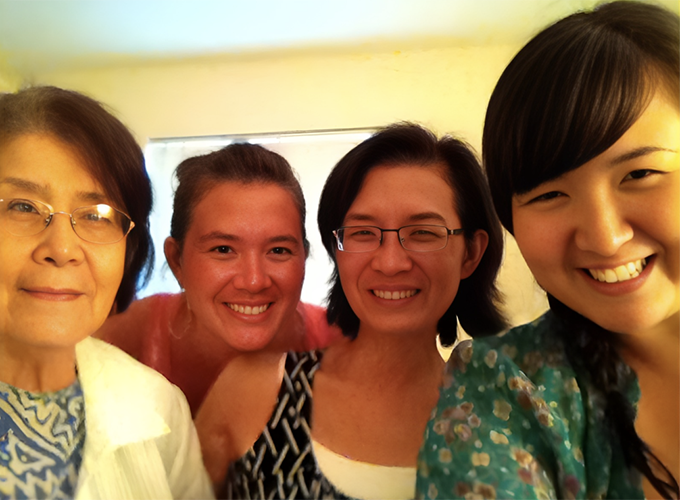 Dr. Kim shared a photo of her mother, daughters, and herself, highlighting three generations who know the importance of “cutting against the grain.”
Helen Kim, Ph.D., associate professor in the Division of Pulmonary, Allergy and Critical Care Medicine, shared beef bulgogi with white rice at the Cultural Connection Food Fair.
This flavor-filled Korean favorite is perfect for cozy family dinners or fun gatherings. Thin slices of beef are marinated in a sweet-savory sauce, cooked until juicy and tender, and served with white rice, japchae, glass noodles, vegetable stir-fry, or the iconic Korean kimchi. Once marinated, the dish can be prepared in less than 20 minutes.
“It doesn’t matter who you are — it’s hard not to love bulgogi,” Kim said. “This traditional beef dish is cooked in a full-flavor mixture of seasoning, including soy sauce, sugar, garlic, green onion, sesame oil and seeds.”
For years, Kim prepared bulgogi using her mother’s recipe. Since her mother’s passing, she said cooking Korean food brings a strong sense of connection.
“I can’t make this dish, or any Korean dish for that matter, without feeling her presence beside me,” Kim said. “I can hear her saying, ‘Helen, didn’t I teach you anything!?’ anytime I try modern variations I’ve seen on social media.”
Regardless of the recipe, Kim and her mother would agree that the key to good bulgogi is slicing the beef against the grain. This can be challenging, but it’s the secret to perfect tenderness.
Kim said white rice is the perfect backdrop to the bold flavors of bulgogi and remains a staple of traditional Korean cuisine. While beef is most common, the dish can also be made with chicken or pork by adjusting the seasoning.
“I enjoy making this dish for larger or holiday gatherings,” Kim concluded. “I am so glad to be able to share this Korean dish with others at UAB.”
Kim named her table, Korea Celebrates the Year of the Fire Horse.
Connecting Food with Culture: Patel’s Story
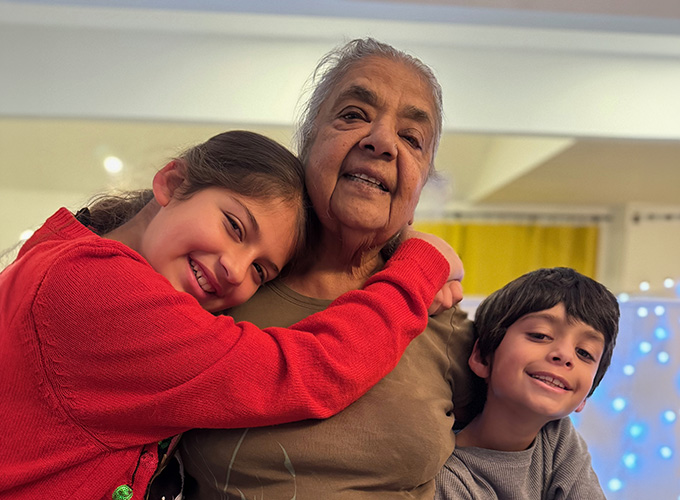 Dr. Patel shared a photo of her mother, also known as the best khaman maker, and her children during the holiday season.
Rena Patel, M.D., associate professor in the Division of Infectious Diseases, shared a dish called khaman at the food fair.
Khaman is a vibrant yellow snack with a savory flavor and a subtle hint of sweetness. Made from chickpea flour and gently steamed, it is light, fluffy, and surprisingly filling. Preparation can take anywhere from 30 minutes to two days, depending on the method used. Comforting yet bold, khaman delivers big flavor and an unforgettable personality.
One of Patel’s favorite traditional treats is khaman, a Gujarati snack her mother has made for as long as she can remember.
“My mom makes the best khaman,” Patel said. “And it’s completely from scratch!”
The dish begins with soaking chickpeas and rice in water at room temperature for one to two days, allowing the mixture to ferment. Once fermented, it is blended with additional grains such as rice or semolina to thicken the batter, then steamed until light and fluffy. It is finished with savory toppings such as mustard seeds, coconut, cilantro, and chilies.
Growing up, Patel’s mother was often asked to make khaman for family gatherings and cultural festivals. Despite preparing the dish countless times, her mother does not follow a written recipe.
“If you asked my mom, she would say, ‘I don’t know, you just make it,’” Patel said, laughing. She added that this is a typical response of many Indian mothers who carry generations of recipes not in cookbooks, but in memory.
Other dishes shared by Patel’s team, Bollywood in Birmingham, included vegetarian samosas and pakora, chicken momo, and mango lassi. Team members Drs. Ranu Surolia, Dhaval Raval, Debasish Chattopadhyay, Shruti Agnihotri, and Pooja Maheria contributed to the success of the event table.
Connecting Food to Culture: Tang’s Story
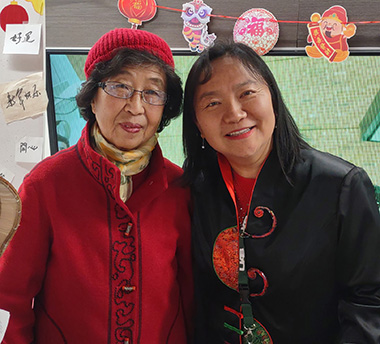 Dr. Tang and her neighbor share traditional Asian food at the Cultural Connections Food Fair
Sharon Tang, M.D., MSHA, is a clinical research coordinator for the Clinical Research Support Enterprise. She shared radish fritters on Thursday evening.
Radish fritters are a savory, pan-fried snack made from shredded daikon radish. They are often paired with a dipping sauce of soy sauce, vinegar, or chili oil. Light yet comforting, the fritters highlight a hallmark of Chinese cooking: transforming vegetables into a deeply satisfying dish.
Often shaped into small rounds, the fritters carry symbolic meaning in Chinese food traditions, representing family reunion and wholeness, while their golden, fried exterior is associated with good fortune and prosperity.
“Honestly, my favorite Asian foods are served hot,” Tang said with a laugh. “We needed dishes that participants could enjoy cold, so we went with crispy radish fritters.”
The dish begins with a mild and juicy white radish called daikon. The vegetable is grated into thin strands and gently squeezed to remove excess moisture. The radish is mixed with a simple batter and seasoned. Some versions include scallions, garlic, or dried shrimp for added flavor. The mixture is formed into small patties and pan-fried until crisp and golden on the outside.
Tang said she is not much of a cook, so she turned to her neighbor, Mrs. Xie, who was eager to help. For Tang, the collaboration represented more than just preparing food.
“Asian people aren’t just close to their families, we’re also close to our community,” Tang said. “In our culture, neighbors help each other. We even share dishes and meals during big events.”
That sense of community, she added, is central to many Asian cultures. “If someone doesn’t know how to cook,” Tang continued, “a neighbor steps in, not out of obligation, but connection.”
With help from Xie, Tang also shared pork skin jelly, cold noodles, and milk tea, turning the gathering into a celebration not just of food, but community.
Thank you to each team for sharing your culture, traditions, and delicious food. Events like this remind us that celebrating our shared human experiences nourishes not just our bodies, but curiosity and connection — something we can all savor.